
How Polygraphiae Made Alphabet Changes Reproducible
Johannes Trithemius gave early printed cryptography a systematic way to change substitution alphabets during a message. His posthumously published Polygraphiae marks an important development in the mechanics of concealed writing: alphabet changes could follow an explicit procedure that sender and recipient could reproduce.
The tabula recta makes that procedure visible. In its modern form, a square contains successive cyclic rearrangements of A through Z. Under the progressive convention examined here, the sender advances through those arrangements as the plaintext advances.
Three principles govern this construction:
- A 26-by-26 matrix supplies every cyclic Caesar shift of the modern alphabet.
- A progressive row schedule changes the substitution for each successive plaintext letter, wrapping back to the beginning after Row 25.
- Changing alphabets disrupts the fixed letter-to-letter correspondence that elementary substitution-frequency analysis exploits.
The historical significance lies in procedural organization. Monoalphabetic methods continued alongside more elaborate systems; a printed description of polyalphabetic substitution did not suddenly transform every diplomatic cipher.
Diplomatic secrecy supplies an obvious practical motive for changing alphabets. Esoteric interpretation approaches the square from another direction: a complete alphabet repeatedly rearranges itself while preserving an underlying order. That formal relationship helps explain the grid's appeal within discussions of concealed knowledge. Claims about particular diplomatic networks or Rosicrucian writers, however, require case-specific evidence.
I regard the distinction between the square and its row-selection rule as the central analytical point. The square provides substitutions; the schedule determines which substitution acts on each letter. The same table can therefore support materially different cipher procedures.
Building the Alphabet Square Without Reversing the Shift
Write A through Z across Row 0. Directly beneath it, begin Row 1 with B, continue through Z, then append A. The alphabet has moved one cell left, although its starting letter has advanced one place.
That distinction prevents a common construction error: shifting the written row in the opposite direction changes every subsequent lookup.
- Draw a square with 26 alphabet cells across and 26 rows down.
- Place row numbers 0 through 25 outside its left edge.
- Fill Row 0 with ABCDEFGHIJKLMNOPQRSTUVWXYZ.
- Build each following row by moving the preceding row's first letter to its end.
- Finish with Row 25: ZABCDEFGHIJKLMNOPQRSTUVWXY.
Row 0 serves both as the plaintext reference and as a usable encryption row. Any separate column labels belong outside the square, just like the row numbers.
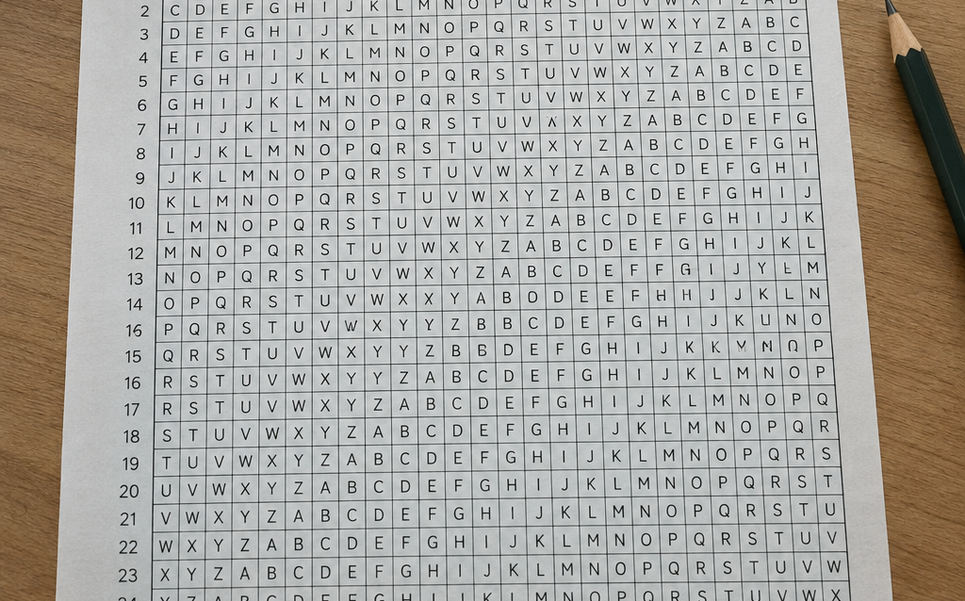
This modern working alphabet preserves the cyclic arithmetic of a 24-letter construction, while changing its dimensions and wraparound point. Reconstructing a historical alphabet requires the letter inventory of the relevant edition. Use the modern square consistently throughout this exercise.
Check Each Intersection With Modular Addition
Assign A = 0, B = 1, continuing through Z = 25. If p denotes the plaintext value and s the row number, the ciphertext value is:
c = (p + s) mod 26.
For E in Row 4, calculate (4 + 4) mod 26 = 8, which gives I. For R in Row 12, calculate (17 + 12) mod 26 = 3, which gives D. The remainder operation handles the alphabet's wraparound and provides an independent check on a handwritten square.
Encrypting and Recovering HERMETIC ORDER
What must the recipient reproduce to recover a message from this grid?
Consider the hypothetical example HERMETIC ORDER. Normalize it to HERMETICORDER: use uppercase letters, remove the space, and advance the row counter only when processing a letter. Begin at Row 0.
For each plaintext letter, find its column in the top reference row, move down to the current shift row, and copy the intersection. Then advance one row. The table follows every lookup; its final column also records the reverse operation.
| Position | Plaintext | Column value | Shift row | Ciphertext | Recovered letter |
|---|---|---|---|---|---|
| 1 | H | 7 | 0 | H | H |
| 2 | E | 4 | 1 | F | E |
| 3 | R | 17 | 2 | T | R |
| 4 | M | 12 | 3 | P | M |
| 5 | E | 4 | 4 | I | E |
| 6 | T | 19 | 5 | Y | T |
| 7 | I | 8 | 6 | O | I |
| 8 | C | 2 | 7 | J | C |
| 9 | O | 14 | 8 | W | O |
| 10 | R | 17 | 9 | A | R |
| 11 | D | 3 | 10 | N | D |
| 12 | E | 4 | 11 | P | E |
| 13 | R | 17 | 12 | D | R |
The completed ciphertext reads HFTPIYOJWANPD.
Decryption reverses the direction of lookup. Find H within Row 0 and trace upward to H. Find F within Row 1 and trace upward to E. Find T within Row 2 and trace upward to R. Continue through the corresponding rows to recover HERMETICORDER.
The arithmetic equivalent is p = (c − s) mod 26. At position 10, ciphertext A has value 0. Subtract shift 9: (0 − 9) mod 26 = 17, recovering R.
The recipient therefore needs the alphabet, starting row, progression rule, and spacing convention. Restoring the word boundary requires a separate reading decision; the letter stream itself carries no space.
Why Changing Alphabets Still Leaves a Predictable Cipher
Progressive substitution breaks the simplest frequency comparison because a plaintext letter loses its single ciphertext identity. In a monoalphabetic cipher, every E becomes the same symbol. A frequent symbol consequently becomes a candidate for E, with language and context guiding the inference.
The worked example exposes the difference directly. E becomes F, I, and P at its successive positions. R becomes T, A, and D. Meanwhile, M and E both produce P. A ciphertext symbol therefore cannot carry one fixed plaintext interpretation throughout the message.
These substitutions disrupt direct frequency matching without ensuring a flat distribution. More importantly, the unkeyed schedule remains public and predictable. Once an analyst recognizes the convention, subtracting each letter's positional shift recovers the plaintext.
Move the Secret Into Row Selection
A repeating keyword changes the problem. Assign each keyword letter its alphabet value and repeat those values as the row schedule. The recipient must reproduce that secret sequence to reverse the substitutions.
Historical attribution needs precision here. Bellaso is associated with an early published repeating-key polyalphabetic method. Vigenère is associated with autokey developments as well as the later naming tradition surrounding the familiar repeating-key cipher. Those constructions have distinct mechanics.
A repeating key also creates a new analytical target: its period. Positions separated by the keyword length use the same shift, allowing an analyst to separate the ciphertext into fixed-shift streams. Keep these procedures within historical reconstruction and cryptanalytic instruction; use contemporary encryption for confidential correspondence.
For the next resilience exercise, retain the tabula recta and replace its public progression with the secret keyword LUMEN: repeat shifts 11, 20, 12, 4, and 13, then examine the ciphertext in groups sharing the same keyword position.