Where Patent Rights Can Enclose Microbial Manufacturing
A synthetic biology patent lockdown describes a proposed enclosure strategy: using patent claims over engineered genetic sequences, metabolic pathways and microbial chassis to control access to industrial biosynthesis. The central concern is licensing leverage over the biological machinery that produces fuels, pharmaceuticals and textile inputs.
The investigative verdict begins with a distinction: ownership of foundational inventions can create bargaining power, while control of manufacturing requires a separate examination of exclusive licences, production capacity and product-market share. Counting patents answers only part of the ownership question.
I begin with four layers: sequence disclosure, issued functional claims, material-transfer permissions and biosynthesis compliance duties. Each creates a different kind of gate. A public sequence supplies information. An issued patent can confer exclusionary rights. A transfer agreement governs access to physical material. A regulatory requirement determines what a proposed activity must satisfy before proceeding.
These gates can accumulate around the same fermentation process. A researcher may obtain a plasmid through an open repository yet still face a relevant process claim, contractual conditions or commercial-use notification requirements. The expense of addressing each gate can influence who enters production.
Patent enforcement and regulatory compliance nevertheless operate through different actors and powers. Their combined expense warrants scrutiny; an allegation of coordinated exclusion requires its own evidence.
This legal discussion concerns the United States; check exclusion rights and compliance duties separately wherever a strain will be made, used, imported or sold.
How a Sequence Listing Becomes a Claim-Mapping Problem
Consider a proposed fermentation strain whose enzyme converts an intermediate into the desired product. Its designer finds a patent application containing numerous related sequences. The useful question is precise: which elements of the eventual issued claims would the strain or production process satisfy?
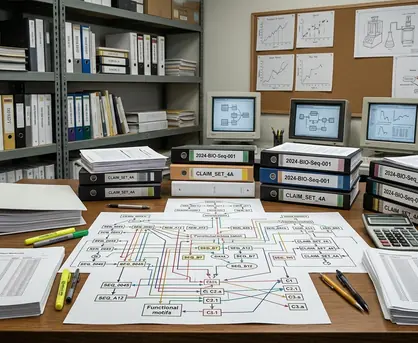
A sequence listing discloses biological information. The issued claim defines the combination for which the applicant obtained protection. That combination may join a sequence-identity requirement to enzyme activity, host-cell characteristics or production conditions. Reading the listing alone collapses these distinctions.
The audit therefore follows the application into examination. Compare the requested claims with the examiner’s objections, the applicant’s amendments and the language that survived. Under 35 U.S.C. §112, written-description and enablement requirements constrain how broadly an applicant can claim a functional category.
Synonymous codon substitutions can encode the same protein. Investigating alleged “codon-variant flooding” therefore requires tracking the disclosed variants into the issued claims and mapping their coverage. A long list of related sequences supplies leads for that examination; its length alone establishes no corresponding number of enforceable monopolies.
Separate Natural DNA From Claimed Engineering
The U.S. Supreme Court ruling in Association for Molecular Pathology v. Myriad Genetics distinguishes naturally occurring DNA merely isolated from nature from patent-eligible subject matter. The broader legal distinction between natural material and human-made biological inventions makes the claimed engineering consequential. A structural modification still needs examination against the actual claim language and patent requirements.
A pathway thicket becomes concrete when overlapping issued claims, held by different owners, reach required steps of the intended fermentation process. Map each owner, each required claim element and each implicated step. That map explains potential licensing dependence far better than a portfolio’s headline size.
When DNA Screening Raises an Institutional Barrier
When does a biosecurity check become an obstacle that favors an established manufacturer over a community laboratory?
Start at the order desk. Customer screening verifies the purchaser; sequence screening evaluates the requested nucleic acid. A delayed order can arise from either process. Identity verification, institutional credentials and sequence content therefore belong in separate columns when examining a supplier’s decision.
U.S. federal screening documents issued during 2023–2024 addressed both checks. The 2023 guidance expanded the screening discussion beyond its earlier double-stranded-DNA focus, while the 2024 framework connected screening expectations to federally supported procurement. Those dates matter when comparing a provider’s policy with an order placed under it.
A credible comparison pairs the community laboratory’s request with an institutional request involving comparable material and circumstances. Preserve the dated provider policy, verification requests and written explanation for any refusal. For an allegation involving corporate agendas, connect a specific lobbying request or consultation submission to the requirement under examination.
Match the Activity Before Comparing the Burden
Commercial fermentation introduces another layer. Under 40 C.F.R. Part 725, certain intergeneric microorganisms intended for commercial use trigger federal biotechnology notification requirements. A microbial commercial activity notice generally must precede the covered activity by at least 90 days.
Compare organism, intended use, containment and regulatory category before drawing conclusions about unequal treatment. Corporate ownership itself creates no exemption from applicable notification duties. The relevant institutional-power question is how the requirement operates across matched activities, including the administrative work each applicant must perform.
The partial answer lies in tracing decisions: who wrote the rule, what information the vendor requested, why the order stopped and which obligation applied. That sequence turns a suspicion of regulatory capture into an investigation with testable claims.
Choosing Public Genetic Parts Without Losing the Patent Trail
A promoter downloaded from an open registry gives a researcher access to sequence information. Permission to redistribute its plasmid and permission to practice a surrounding fermentation process require separate checks. This public-plasmid boundary is where a practical audit should begin.
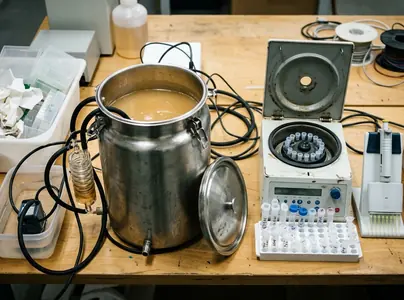
- Define the intended function. Record the host, enzyme activity, production conditions and exact version of each proposed genetic part.
- Capture the disclosure history. Save the sequence, accession version, retrieval date, public disclosure date and material-transfer terms.
- Search beyond sequence identity. Examine enzyme functions, inventors, cited patent families and issued claims alongside sequence similarity.
- Check each family member’s status. Distinguish grants, pending claims, expiration, lapse and abandonment. Assess later improvements separately.
- Document the replacement decision. Connect the selected part and intended process to the relevant claim assessment and distribution permissions.
Under 35 U.S.C. §154, the ordinary utility-patent term generally ends 20 years from the relevant filing date, subject to statutory adjustments and other provisions. Use the filing and legal-status history when evaluating expiration.
Defensive publishing addresses future claims by establishing a sufficiently informative public disclosure as prior art under 35 U.S.C. §102. Preserve the date when both sequence and functional description became publicly accessible. Open transfer terms can authorize plasmid sharing, while existing third-party rights require their own assessment.
At the community-lab bench, you compare the plasmid’s promoter sequence with the open registry on your laptop. You record the accession version, check the corresponding claims and save the replacement vector’s distribution terms. Beside the benchtop thermocycler, the documented public-domain part replaces the proprietary vector in your protocol. You prepare the amplification run.