
In this Article
- What Operation Susannah tried to achieve
- Why the Suez withdrawal mattered
- The aliases, incendiaries and Rio Cinema arrest
- The Cairo sentences and Israel’s authorization dispute
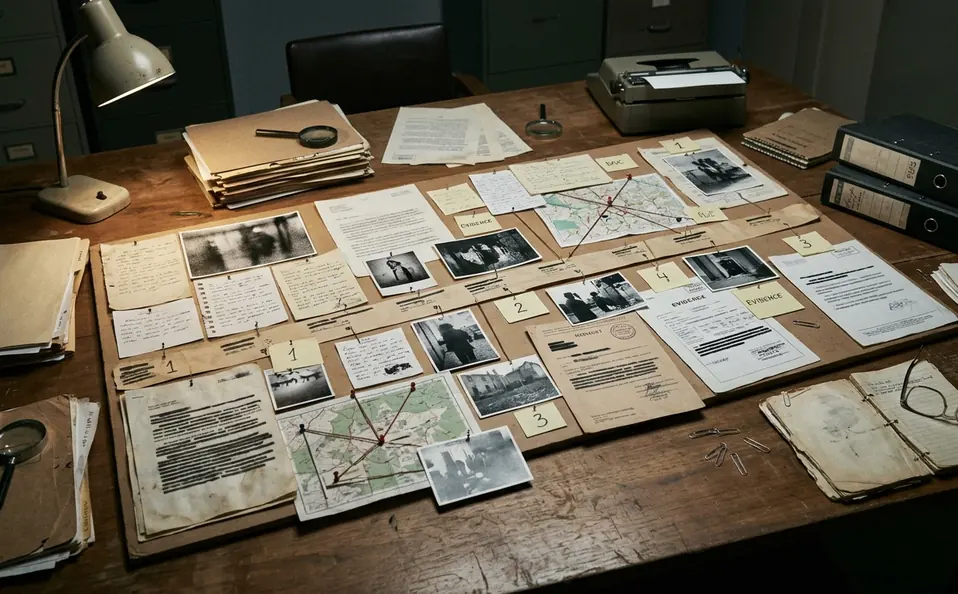
- Reconstructing the operation through an evidence ledger
Operation Susannah: Civilian Attacks Designed to Shift the Blame
A false flag is a clandestine operation designed to make an adversary appear responsible for someone else’s actions. The mechanism joins an attack to a misleading attribution: the perpetrators act, suspicion falls elsewhere, and the sponsor seeks a political advantage from that confusion.
Operation Susannah fits that definition. In July 1954, Israeli military intelligence activated an Egyptian Jewish network associated with Unit 131 to attack civilian institutions in Egypt. The intended effect was to make Egyptian nationalist, Islamist or communist agitation appear responsible for insecurity, undermining confidence in Cairo as Britain negotiated its withdrawal from the Suez Canal zone.
The targets mattered. Attacks on Western-associated premises could carry a diplomatic message to London and Washington: Egypt could not protect institutions connected to their interests. Blame directed toward groups such as the Muslim Brotherhood or local communists would help conceal the operation’s sponsor.
The operation failed to prevent the withdrawal agreement. Its exposure began when Philip Natanson’s incendiary device ignited prematurely outside an Alexandria cinema on 23 July. Britain and Egypt initialed their agreement four days later.
The bombings caused no deaths. Calling them casualty-free, however, erases Natanson’s burns. Nor does the initial arrest establish that investigators identified and detained every participant within days. The ignition, subsequent searches and eventual prosecution belong to a sequence that needs reconstructing rather than compressing.
Count the Burns
Use “no deaths” when describing the attacks. Natanson’s injury makes “zero casualties” inaccurate, even though the devices did not produce the mass fatalities associated with many later attacks on civilians.
Defense Minister Pinhas Lavon resigned in February 1955 after an Israeli inquiry failed to resolve who had authorized activation. The resulting controversy became known as the Lavon Affair, or HaEsek HaBish, “The Unfortunate Affair.”
Its wider significance lies in the political cost of deniable action: exposure can leave the sponsoring institution identifiable while senior officials contest responsibility. Claims that Susannah permanently reorganized intelligence agencies worldwide reach beyond the available evidence.
The Suez Withdrawal Put a Diplomatic Deadline on Sabotage
On 27 July 1954, Britain and Egypt initialed an agreement governing evacuation of the British canal base. The formal signature followed on 19 October. The agreement provided for withdrawal within 20 months, and Britain completed it in June 1956.
Place those dates beside the July attacks and the operation’s strategic logic becomes visible. Israeli planners regarded the British military presence as a constraint on Egypt. Its departure would give Cairo greater freedom of action and remove a substantial foreign military presence from Egyptian territory.
Calling that garrison a “buffer” can mislead. British troops occupied a strategic base inside Egypt; they did not form a literal line separating the Egyptian and Israeli armies. The distinction matters because it explains what the covert operation sought to preserve: a constraint on Egyptian power, rather than a border deployment.
Western Institutions as Diplomatic Leverage
Britain sought an agreed evacuation arrangement that retained specified rights to reactivate the base. The Eisenhower administration supported a negotiated settlement rather than indefinite British occupation. Sabotage therefore had to interfere with an existing diplomatic direction.
The choice of Western-associated civilian targets served that purpose. If attacks suggested that Gamal Abdel Nasser’s government could not maintain security, British and American officials might reconsider the risks of withdrawal. The operation sought to turn a negotiated settlement into an apparent security liability.
That was the calculation. The agreement’s July initialing and October signature provide a concrete test of its failure.
The Disputed Order Behind Unit 131
Who authorized the activation? Military intelligence chief Colonel Binyamin Gibli maintained that Lavon had given the order. Lavon denied responsibility. The dispute became central to the Israeli investigation and remained unresolved by the initial inquiry.
Keep the operational connection and the ministerial allegation in separate files. Evidence tying the network to Israeli military intelligence does not automatically establish Gibli’s account of a verbal instruction. Treating those propositions as interchangeable gives disputed testimony more weight than it can carry.
This is where a discussion of geopolitics and intelligence needs documentary discipline. A plausible strategic motive explains why an institution might act. Establishing who actually ordered it requires evidence of the decision.
Dar’s Alias, Elad’s Handling and the Rio Cinema Arrest
How many people sit behind the names John Darling and Paul Frank? Getting that question wrong produces a fictitious command structure before the investigation even reaches the attacks.
Avraham Dar recruited Egyptian Jewish operatives beginning in 1951 under the British identity John Darling. Avri Elad later became the handler associated with the 1954 operation and used the identity Paul Frank. Darling was Dar’s cover identity, not a separate commander working alongside Elad.
Dar and Darling identify one person. Elad and Frank identify another. An alias belongs in the identity record, not in an extra box on the command chart.
The recruits received clandestine training. Their participation documents the actions of particular individuals and an intelligence network; it supplies no basis for assigning collective responsibility to Egyptian Jews.
Small Devices, Strategically Chosen Targets
Published chronologies place an attack on an Alexandria post office on 2 July 1954, followed by attacks on American information libraries in Cairo and Alexandria on 14 July. Accounts describe incendiaries concealed in everyday objects, including eyeglass cases and books, with delayed ignition intended to separate placement from combustion.
The concealment is relevant because it shows how ordinary civilian surroundings could accommodate the devices. A detailed chemical recipe would add false precision here. The supplied evidence supports a description of concealed incendiaries and delayed ignition, without establishing every claimed ingredient or mechanism.
The contrast between target selection and execution deserves attention. The institutions carried international political significance; the delivery relied on small, improvised devices carried by local operatives. That mismatch tells us about the operation’s practical vulnerabilities. On its own, it cannot identify a sponsor.
The Ignition That Exposed the Network
On 23 July, Natanson’s device ignited prematurely outside the Rio Cinema in Alexandria. He suffered burns, and the incident began the network’s exposure.
That moment gives the reconstruction a firm anchor. It does not settle every question about what Egyptian security already knew, how investigators developed their leads, or whether a handler betrayed the network. Elad later attracted suspicion of acting as a double agent; suspicion should remain distinct from an established explanation of the arrest.
The defensible sequence begins with the premature ignition and arrest, then follows searches, identifications and testimony. Each link needs its own support. Writing the entire collapse as an automatic consequence of poor compartmentalization would substitute an appealing intelligence lesson for a demonstrated chain of events.
Cairo’s Sentences and the Authorization Dispute in Israel
The consequences unfolded in separate arenas. Egypt prosecuted captured operatives. Israeli officials investigated responsibility for activation. The courtroom outcomes were concrete; the authorization dispute proved much harder to close.
The Cairo trial opened on 11 December 1954, and judgments followed on 27 January 1955. Moshe Marzouk and Shmuel Azar were executed by hanging on 31 January.
- Victor Levy and Philip Natanson: life sentences.
- Marcelle Ninio and Robert Dassa: 15-year sentences.
- Meir Meyuhas and Meir Zaafran: seven-year sentences.
Max Binnet died by suicide in Egyptian custody on 21 December 1954. Adding another custodial suicide without a traceable identification and connection to these proceedings would corrupt the record.
Lavon’s Resignation Did Not Settle the Order
The January 1955 Olshan–Dori inquiry failed to establish whether Lavon had issued the activation order. His resignation followed in February. Later investigations exposed defects in the evidence used against him, including manipulated testimony and forged material, reviving the dispute and intensifying his conflict with David Ben-Gurion.
Those developments make source chronology unusually important. A contemporary allegation and a later finding that evidence was manipulated cannot occupy the same evidentiary position. Readers need to know when an account emerged and what subsequent inquiries did to its credibility.
Nor should the political timeline be shortened into an immediate collapse of Moshe Sharett’s government. Sharett remained prime minister until November 1955. Ben-Gurion’s January 1961 resignation belongs to a later phase of the controversy.
The Road to Suez Had Other Turning Points
The affair damaged the setting for Egyptian-Israeli contacts and exposed the conflict between covert action and diplomacy. Describing it as the single event that killed peace and produced the 1956 war makes the causal chain too neat.
The 1955 Egyptian-Czechoslovak arms agreement, Egypt’s nationalization of the canal in July 1956, and subsequent British-French-Israeli coordination remain essential to that explanation. Susannah belongs within this history, with its own consequences and its own limits.
This account reconstructs events through published sources. It does not claim direct inspection of Egyptian tribunal files or archival verification in Cairo, Jerusalem and Washington.
References
- Shabtai Teveth, Ben-Gurion’s Spy (1996), for the intelligence operation and political dispute.
- Joel Beinin, The Dispersion of Egyptian Jewry (1998), for the affair within Egyptian Jewish history.
- Foreign Relations of the United States (FRUS) declassified diplomatic cables on Egypt, for the contemporary diplomatic setting in the 1952–1954 collection. Diplomatic reporting must still be distinguished from firsthand operational evidence.
Rebuild the July 1954 Case Before Testing a Modern Allegation
I start with a ledger: one claim per row, with the supporting document beside it. Operation Susannah supplies a worked case because its documented intelligence connection lets us test which observations establish attribution and which merely raise questions.

Use the following sequence to build that ledger before applying the method to a contemporary incident.
-
Align the Attacks With the Withdrawal Negotiations
Create separate attack and diplomatic chronologies. Enter the Alexandria post-office attack on 2 July, the information-library attacks on 14 July and Natanson’s exposure on 23 July. Then enter the evacuation agreement’s initialing on 27 July and signature on 19 October.
Write the finding narrowly: the attacks coincided with the final approach to an evacuation agreement. The four-day interval between exposure and initialing establishes proximity. It cannot identify who issued the activation order.
-
Separate Target Choice From Device Evidence
Open distinct fields for the premises targeted, the objects used for concealment, and the source describing the devices. Enter Western-associated information libraries under target selection and reported eyeglass-case or book concealment under delivery.
The worked conclusion is that strategic target selection coexisted with improvised incendiary delivery. Leave unsupported chemical details blank. When testing a modern allegation, treat a similar mismatch as a question about execution rather than proof of state sponsorship.
-
Link Each Alias to Its Documented Identity
Enter “Avraham Dar; alias John Darling” in one identity record and “Avri Elad; alias Paul Frank” in another. Put Dar’s recruitment activity and Elad’s later handling role in separate activity fields.
This prevents a common analytical error: turning cover names into extra participants, then inventing relationships to connect them. Extend a command chart only when a source supports the relationship.
-
Keep the Sponsor and the Disputed Order Separate
Record the network’s Israeli military-intelligence connection as one proposition. Record Gibli’s allegation that Lavon authorized activation as another. Attach the unresolved Olshan–Dori finding and later evidence problems to the authorization entry.
The resulting assessment can establish institutional responsibility while leaving the particular ministerial instruction unresolved. That distinction preserves what the evidence actually supports.
-
Finish With a Traceable Finding
For each cable, transcript or published account, record its creation date, author, recipient, archival location or publication details, and whether it offers firsthand, reported or retrospective information. Keep the document’s creation date separate from any later declassification date.
Now complete the ledger with the findings below. Use these entries as the model for your own evidence file: observation first, bounded conclusion second.
| Audit step | Record to obtain | Worked finding | Evidentiary status |
|---|---|---|---|
| Diplomatic timing | Dated attack chronology and agreement documents | Exposure on 23 July preceded initialing on 27 July by four days. | Establishes proximity, not authorization. |
| Physical delivery | Source-specific accounts of targets and incendiaries | Western-associated premises were attacked with concealed, improvised devices. | Describes execution; does not independently identify the sponsor. |
| Identity control | Recruitment and handler accounts | Dar used Darling; Elad used Frank. | Links aliases without adding fictional commanders. |
| Authorization | Gibli’s allegation, inquiry findings and later evidence assessments | The military-intelligence connection and Lavon’s alleged instruction require separate entries. | The initial inquiry left the ministerial order unresolved. |
| Outcome check | Agreement signature and evacuation chronology | The agreement was signed in October 1954; withdrawal finished in June 1956. | The operation failed to stop the negotiated withdrawal. |