Mainstream history likes a clean staircase: tools get better, settlements get larger, states emerge, writing follows, and the archive becomes legible. Field evidence rarely behaves that neatly.
I treated this list as an evidence audit, not a confirmation exercise. Each case has to answer three questions before it earns a place here: what exists physically, what was tested or mapped, and where the interpretation starts to outrun the sample.
In this Article
- The Fragments That Break the Timeline
- Criteria for Selection: Defining an Archaeological Anomaly
- The 9,500-Year-Old Submerged City of India
- The Ataxite Meteorite Buddha of Tibet
- The Epiclassic Elongated Skulls of Sonora, Mexico
- The High-Density Pyramids of Sedeinga, Sudan
- The Taxonomically Anomalous Sealand Skull
- The Deep-Water Megaliths of the Cuban Coast
- Scope and Limitations
- What These Artifacts Actually Challenge
The Fragments That Break the Timeline
Ancient artifacts become dangerous to tidy narratives when they do not merely look strange, but sit in a documented context that strains the expected chronology. A carved object is interesting. A carved object with a tested material profile, a recoverable chain of custody, and a date attached to the right layer is something else.
Recent work with side-scan sonar, sub-bottom profiling, ground-penetrating radar, geochemical testing, and radiocarbon dating has widened the field. Marine shelves now produce patterns that earlier archaeologists could not see. Testing teams can identify meteoritic iron from its nickel-rich chemistry. Skeletal collections can separate cultural body modification from claims of unknown species.
That does not mean every anomaly rewrites history. It means the first draft was incomplete.
Note: Radiocarbon dating measures organic material, not stone architecture. It can support a site chronology only when the dated sample comes from a secure archaeological layer.
Criteria for Selection: Defining an Archaeological Anomaly
What makes an object worth including in a serious list of mysterious ancient artifacts?
The threshold is practical. First, the object or structure must have a physical basis: an excavated burial, a mapped seabed formation, a curated specimen, a documented monument. Second, it needs analytical attention, such as Carbon-14 documentation, geochemical testing, professional mapping, or published field notes. Third, it must press against an accepted timeline or category in a direct way.

For submerged structures, the minimum useful record includes the survey date range, approximate depth, imaging method, geographic setting, and whether divers or remotely operated vehicles recovered samples. For anomalous human remains, the record should include burial count, dating method, cultural context, skeletal description, and professional osteological review.
This filter is conservative by design, because acoustic geometry or a dramatic skull shape can mislead when it is separated from excavation context.
1. The 9,500-Year-Old Submerged City of India
What the Gulf of Khambhat claim shows
The strongest version of the Gulf of Khambhat case starts with real survey work. In 2001 and 2002, India’s national ocean-technology institute publicized marine surveys using side-scan sonar and sub-bottom profiling in shallow conditions. Reported features lay roughly 20 to 40 meters below present sea level.
That depth matters. It fits a coastal landscape affected by post-Ice Age shoreline movement. It does not, by itself, identify a city.
Organic material recovered by dredging was reported with dates around the late 8th millennium BCE, often summarized as roughly 9,500 years old. If those samples belonged securely to built features, the implications would be severe: organized construction in a period usually placed before the first urban civilizations of Mesopotamia.
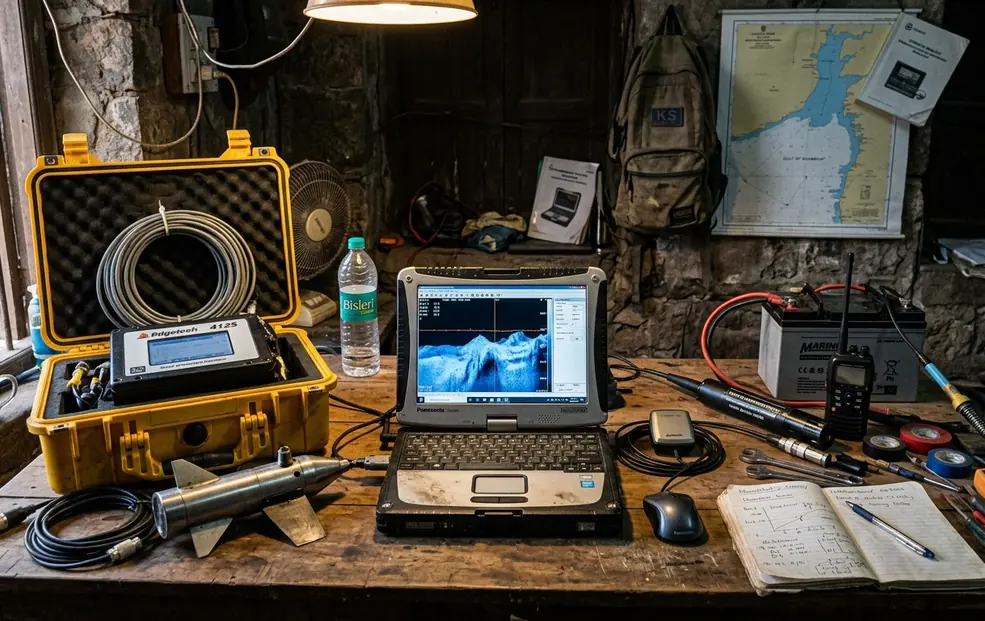
Here is the catch. A radiocarbon date from dredged wood in the Gulf of Khambhat dates that organic sample, not automatically the sonar pattern nearby. Currents can move wood, bone, and pottery. Dredging can mix layers. The acoustic data remain intriguing, but the leap from recovered organic material to a planned urban settlement is not secured.
2. The Ataxite Meteorite Buddha of Tibet
The object commonly called the Iron Man statue is a real material anomaly. It is reported at about 24 centimeters high and roughly 10 kilograms in mass, and a 2012 meteoritic-material study identified its metal as ataxite iron consistent with the Chinga meteorite field.
That field, in the Tuva region, has fragments documented from the early 20th century. The statue is often described as a representation of Vaisravana and linked to a 1938 German expedition to Tibet led by zoologist Ernst Schäfer. The chain of possession, however, is poorly documented, and that weakens the historical story around the object.
The important point is narrower than the legend. Carving high-nickel meteoritic iron is unusual. It suggests knowledge of a difficult material and the tools to work it. It does not certify a lost technological civilization.
Comparisons demonstrate a useful distinction: the metal composition can be studied; the expedition romance must be checked against custody records.
3. The Epiclassic Elongated Skulls of Sonora, Mexico
Alien biology, or human culture written on bone?
The Onavas cemetery in Sonora is often dragged into speculative territory because the skulls look dramatic. That is the wrong starting point. The better question is cultural: who modified these bodies, and what connections did those practices reveal?
Mexico’s federal archaeology authority reported 25 burials from the cemetery, broadly dated to about 900 to 1200 CE. Public excavation summaries described 13 individuals with intentional cranial deformation and 5 with dental modification. The cranial form matches fronto-occipital deformation produced by binding or pressure boards during infancy, when cranial bones remain malleable.
The Onavas skulls show that an unusual body form can result from documented cultural modification rather than unknown taxonomy.
The dental work deserves closer attention. Shaped or filed teeth are better documented farther south in Mesoamerica. In Sonora, that pattern points toward cultural contact, status signaling, mobility, or some combination of the three. The anomaly is not a new species. It is a northern burial ground carrying practices that complicate local development models.
4. The High-Density Pyramids of Sedeinga, Sudan
Sedeinga is not mysterious because the builders had impossible engineering. It is mysterious because the cemetery compresses a lot of architectural decision-making into a tight ritual landscape.
Between 2009 and 2012, excavators documented 35 small pyramids at the site in northern Sudan. The cemetery belongs to the Kushite-Meroitic cultural sphere, broadly spanning the first millennium BCE through the early centuries CE, with many monuments roughly around two thousand years old.
Some pyramids included circular internal masonry features described as cupola-like forms, with cross-bracing elements running toward the corners. That local design vocabulary matters. It suggests builders working within a Kushite-Meroitic funerary tradition while solving spatial and structural problems on their own terms.
The density is the clue. One excavated zone contained many monuments packed into a limited cemetery area, indicating repeated funerary construction inside constrained space rather than a single royal pyramid complex modeled on Egypt.
5. The Taxonomically Anomalous Sealand Skull
The Sealand Skull is the weak entry, and it should be treated that way.
Popular accounts place its discovery near Olstykke, Denmark, in 2007 during work connected to domestic infrastructure. Secondary claims allege a medieval radiocarbon range, often repeated as the 13th century CE, with references to testing associated with the Niels Bohr Institute. But no verifiable test report is publicly tied to a curated specimen.
That missing paperwork is not a minor inconvenience. Claims that the cranium failed Linnaean taxonomy require peer-reviewed osteological description, comparative measurements, DNA analysis, or a museum accession record. At present, those supports are absent.
Reporting confirms the popular story exists. It does not confirm the taxonomic claim.
Note: As evidence for undocumented hominids, this case does not meet the threshold used for accepted fossil or archaeological human remains.
6. The Deep-Water Megaliths of the Cuban Coast
When sonar looks like architecture
The Cuban offshore formations entered the anomaly file in 2001, after a private marine survey team used side-scan sonar and later remotely operated vehicle imagery off western Cuba. The images were described as symmetrical formations resembling massive stone blocks or urban planning.
Depth changes the case.
The reported formations sit roughly 600 to 750 meters below sea level. Within established frameworks, global sea level at the Last Glacial Maximum was about 120 to 130 meters lower than today. That is not enough. The Cuban offshore case is a failure case for Ice Age exposure claims because reported depths near 600-750 meters exceed known late-glacial sea-level lowering by several hundred meters.
Without datable construction material, tool marks, stratified artifacts, or excavated architectural blocks, the site remains an acoustic-imaging anomaly. It may deserve further mapping. It is not a verified city.
Scope and Limitations
These cases sit on different evidentiary tiers. Sedeinga and Onavas are solid archaeological discoveries with regional consequences. The meteorite statue is a genuine material puzzle wrapped in a disputed provenance. Khambhat remains contested because the dates belong to recovered organic material, not securely to the mapped seabed forms. Cuba is remote sensing without excavation. Sealand is weaker still.
Ground-penetrating radar, side-scan sonar, and sub-bottom profiling detect contrasts, reflectors, and shapes. They do not identify function without excavation or sample recovery. Carbon-14 is powerful for once-living material within a late Quaternary range, but it cannot directly date stone blocks.
The best revision cases require convergence: mapped context, repeatable measurements, datable material, independent testing, and publication or archive access.
Acoustic geometry or radiocarbon age can revise history only when tied to a documented sample chain, a mapped excavation context, and independent test reporting; otherwise it remains a survey lead rather than a dated settlement.
What These Artifacts Actually Challenge
The entries span a wide chronological field: possible early Holocene material claims in India, first-millennium CE funerary architecture in Sudan, 900 to 1200 CE modified remains in Mexico, and a disputed medieval-date skull claim in Denmark. They do not point cleanly to one hidden global civilization.
They point to something more useful.
Local societies produced complex, region-specific practices that later summaries flattened, misplaced, or treated as peripheral. Sudanese pyramid builders adapted a cemetery under pressure. Sonoran communities marked bodies in ways that hint at wider Mesoamerican contact. A meteoritic iron statue reminds us that unusual materials can move through ritual and political networks before historians know how to classify them.
The next step is not louder speculation. It is targeted excavation, curated samples, independent testing replication, and transparent publication of raw measurements. History changes when the artifact, the layer, and the test result hold together.