In this Article
- Executive Summary: The Multi-Polar Rearmament
- The "Carrier Killer" and Asian Power Shifts
- Covert Proliferation: From Smiling Buddha to Black Projects
- Proxy Wars and the Scramble for Strategic Resources
- The Unmanned Frontier: Drones and Directed Energy
- Investigative Scope and Limitations
Executive Summary: The Multi-Polar Rearmament
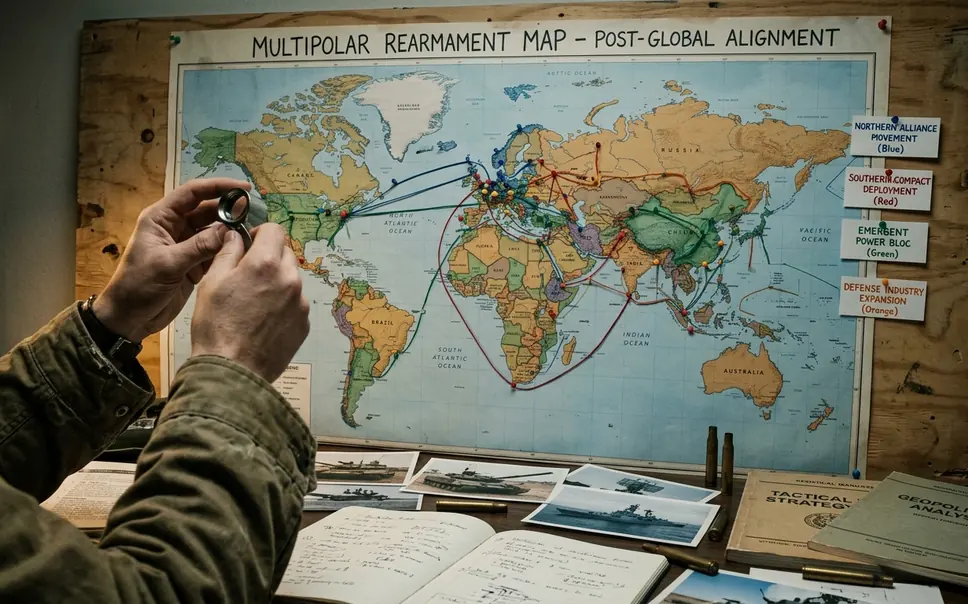
The arms race now under way is not a single contest between two blocs. It is a more unstable thing: a multi-polar rearmament shaped by regional fear, resource exposure, industrial ambition, and the declining ability of old security guarantees to settle disputes before they become procurement orders.
Evaluations reveal a blunt starting point. The Stockholm International Peace Research Institute reported global military expenditure at US$2.443 trillion for calendar year 2023 in its April 2024 release, the highest level in its historical series. Arms-transfer rankings for 2019-2023 showed India, Saudi Arabia, Qatar, Ukraine, Pakistan, Japan, Egypt, Australia, South Korea, and China among the largest importers. To follow how the global arms trade grew, I start with transfer behavior rather than official speeches.
That distinction matters. Public rhetoric tends to frame weapons buying as defensive necessity. Procurement records show something colder: states are purchasing ways to deny access, survive blockade, hit deeper, and fight through proxies when direct war carries too much risk.

What changed in the field
From February 2022 through late 2024, reporting from Ukraine documented reconnaissance quadcopters, one-way attack drones, loitering munitions, and counter-drone electronic warfare at brigade and battalion level. These were not boutique tools held by national air forces. They became everyday instruments of tactical life.
At the same time, uranium and oil stopped looking like background commodities. After the July 2023 military takeover in Niger, uranium-sector risk became operationally visible because Niger had been a recurring supplier of natural uranium to European utilities. In the Red Sea and Persian Gulf from 2022 through 2024, missile, drone, and seizure risks altered tanker routing, naval escort planning, and insurance assessments.
Summary: The present arms race is not only about faster missiles or larger budgets. It is about states trying to insure themselves against supply disruption, maritime exclusion, and deniable violence.
The "Carrier Killer" and Asian Power Shifts
What does naval power mean when a road-mobile missile can threaten a capital ship from beyond 1,500 kilometers?
That question sits at the center of China’s DF-21D program. Public U.S. defense assessments have described the DF-21D as an anti-ship ballistic missile designed to hold large surface vessels at risk inside the western Pacific. The point is not that one missile ends American sea power. That is too theatrical. The point is that a carrier strike group, once treated as a floating symbol of escalation dominance, now operates inside a denser cost-imposition field.
Tracking data indicates a second layer of evidence: test infrastructure. Commercial satellite imagery from 2013-2021 showed carrier-shaped and pier-like target structures in inland Chinese ranges. By late 2021, imagery from a Xinjiang desert range showed a carrier-sized rail-mounted target form. That suggests work on detection, tracking, or terminal-aiming procedures against moving naval-scale objects, not merely static concrete.
Missiles and oil belong in the same analysis
Beijing’s western Pacific posture cannot be separated from its energy posture. Between 2008 and 2010, Chinese state-linked firms obtained roles in major Iraqi oilfield service arrangements, including Al-Ahdab, Rumaila, and Halfaya. During the same period, Beijing and Baghdad publicly discussed large-scale Iraqi debt relief while Chinese entities expanded upstream oil access.
Here the record requires discipline. Public records support debt relief and oilfield access. They do not confirm a Middle East-to-China pipeline system as a settled fact. Still, the strategic pattern is legible: deny adversaries freedom of maneuver near China’s maritime approaches while securing energy positions far beyond those waters.
That is not contradiction. It is hedging.
Covert Proliferation: From Smiling Buddha to Black Projects
Begin at Pokhran, 18 May 1974. India conducted its first underground nuclear test under the name Smiling Buddha, and the plutonium pathway is commonly linked in proliferation literature to the Canadian-supplied CIRUS research reactor and foreign-supplied heavy water. It was not, in the stricter technical record, a standard civilian CANDU power reactor story.
That correction is not pedantry. It changes how one reads the case. The lesson of 1974 was not simply that civilian nuclear cooperation could be misused. It was that reactor provenance, heavy-water access, fuel cycles, and political intent could combine in ways supplier states had not fully controlled. The test influenced export-control tightening in the mid-1970s, including the formation of a supplier-control regime intended to restrict nuclear technology transfers usable for weapons programs.
The long arc of strategic autonomy
India’s later strategic systems followed a public rhythm with classified interior spaces. The Agni-V missile was first publicly flight-tested on 19 April 2012, and subsequent announced tests through the 2010s and early 2020s were framed by Indian authorities as part of validating long-range deterrence. INS Arihant was launched on 26 July 2009, entered service in the mid-2010s, and India announced completion of its first SSBN deterrent patrol in November 2018.
The unmanned side matters because it points toward a different future of attribution. India’s flying-wing unmanned combat aircraft effort moved from concept references in the late 2000s and early 2010s toward demonstrator activity by July 2022, when an autonomous flying-wing technology demonstrator was publicly reported to have flown.
The implication is uncomfortable. Nuclear deterrence once depended on visible state responsibility. Autonomous strike systems, stealth profiles, and ambiguous command chains push in the opposite direction. They invite the possibility of force that arrives before attribution hardens.
Note: Classified design details are not knowable from the public record. The responsible claim is capability development, not hidden inventory counts or undisclosed strike doctrine.
Proxy Wars and the Scramble for Strategic Resources
The cleanest resource-war case is not the one most often invoked in casual commentary. It is eastern Democratic Republic of Congo, where coltan-linked conflict has remained visible in open reporting. From 2022 through 2024, United Nations expert reporting documented armed-group taxation, smuggling routes, and cross-border support allegations around mineral-rich areas in North Kivu and South Kivu.
That is the field pattern: armed groups do not need to own the global supply chain. They need to tax roads, intimidate miners, control chokepoints, and sell into networks that launder violence into commerce.
The Sahel correction
French forces began intervention in Mali on 11 January 2013. The initial combat phase ran into 2014 before shifting into a broader Sahel counterinsurgency posture. It is tempting to describe that intervention as direct protection of Malian uranium mines. The record does not support that in a strong form.
The stronger uranium-security link runs through Niger, especially the Arlit and Akouta mining area, while Mali mattered more as regional security depth and exploration terrain than as confirmed operating French uranium extraction. After Niger’s July 2023 military takeover, the risk became harder to ignore: uranium-sector reporting, military access, and diplomatic ties with Western states all deteriorated during 2023-2024.
There is another layer, darker and less settled. A February 2013 press allegation claimed Saudi prisoners were offered sentence relief to fight abroad. No public court record, United Nations finding, or official Saudi confirmation substantiated that claim in the 2014-2024 public record. I would not build a doctrine on it. I would keep it in the file as an allegation that matches a broader pattern of states seeking deniable manpower.
- Confirmed pattern: mineral corridors create revenue opportunities for armed groups.
- Confirmed pattern: uranium supply risk affects European nuclear-fuel planning.
- Unconfirmed allegation: sentence commutation for proxy fighters requires stronger public evidence.
The Unmanned Frontier: Drones and Directed Energy
Drones changed the price of seeing.
That may be their most important contribution. Iran publicly displayed the Shahed-129 in September 2012, and by the mid-2010s open-source conflict monitoring associated the type with surveillance and strike activity in Syria and Iraq. After March 2022, small tactical loitering systems became more visible when the United States publicly announced transfers to Ukraine, followed by battlefield reporting of use against vehicles, trenches, and exposed personnel.
From 2022 through 2024, Russian and Ukrainian forces used first-person-view drones at tactical depth, often pairing cheap airframes with improvised munitions and electronic-warfare countermeasures. The result was not a simple drone revolution. It was a contest between airframes, jammers, operators, batteries, weather, artillery links, and the speed at which units learned.
Lasers are a counter-drone answer, not magic
Comparisons demonstrate a useful distinction between fielded drone effects and directed-energy ambition. Public U.S. naval testing of a shipboard laser weapon occurred during the 2014-2017 period at roughly the tens-of-kilowatts class. Those demonstrations engaged small boats and unmanned aerial targets. They did not establish strategic missile defense.
Laser-induced plasma channel research appeared in public defense-research language during the 2012-2015 period as a possible way to guide energy through air. The public record supports experimental investigation, not an operational battlefield weapon.
Quick Tip: When assessing a secret-weapons claim, separate demonstrated field use from research status. Drones have extensive combat evidence. Laser-plasma systems, in the public record, remain research-bound.
Investigative Scope and Limitations
This analysis relies on declassified government material, public defense assessments, commercial satellite imagery reporting, international arms-transfer datasets, reactor-fuel supply reporting, and United Nations expert reports. I give those sources more weight than anonymous claims because weapons programs leave infrastructure, procurement, test ranges, launch dates, and supply-chain traces.
The arms-transfer baseline covers public datasets through calendar year 2023, with major 2019-2023 trend releases published in 2024. The China missile and naval-target material was checked against public defense assessments released from 2020 through 2024 and commercial satellite imagery reporting from 2013 through 2021.
The nuclear-proliferation timeline uses fixed public markers: 18 May 1974 for India’s first nuclear test, 19 April 2012 for Agni-V’s first public flight test, 26 July 2009 for INS Arihant’s launch, and November 2018 for India’s announced first SSBN deterrent patrol. The Sahel section relies on the January 2013 start date of French intervention in Mali, Niger uranium-sector reporting through 2023-2024, and United Nations expert reporting on mineral-linked armed groups in eastern Congo through 2024.
The methodology has a blind spot. It sees what states expose through tests, contracts, imagery, transfers, and battlefield debris. It cannot establish exact hidden inventories, warhead counts, or undisclosed rules of engagement.