Defining Operation Gladio: The Core Framework
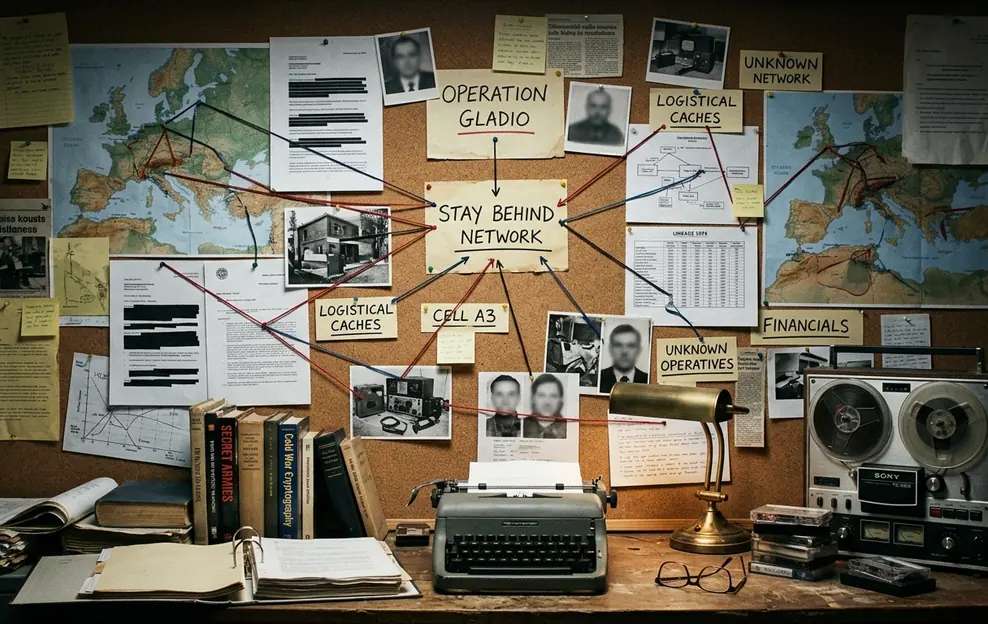
Operation Gladio was Italy’s clandestine stay-behind paramilitary organization, built to resist a potential Soviet occupation through intelligence collection, sabotage, communications, and escape support. Italy’s military intelligence service and the CIA formalized their relationship in a November 1956 agreement. Comparable organizations existed elsewhere in Western Europe under NATO-associated coordination, but “Gladio” was not their universal codename.
Summary:
- Gladio belonged to a broader family of nationally controlled Cold War stay-behind networks.
- The documented core mission was resistance after invasion, supported by trained personnel, concealed equipment, radios, and compartmented command channels.
- Security officials also maintained documented contacts with anti-communist extremists in particular national cases.
- Claims that NATO or Gladio centrally directed specific terrorist attacks remain disputed and require incident-level evidence.
- This investigation focuses on operational structure, logistics, the Strategy of Tension, public exposure, and archival research.
In this Article
- How NATO structured the stay-behind armies
- How covert cells managed weapons and logistics
- How the Strategy of Tension manipulated public perception
- How investigators uncovered the secret network
- How to trace Gladio’s blueprint in modern geopolitics
- How to access and analyze declassified archives
The central analytical problem is one of evidentiary separation. The invasion-resistance system is well documented. Contacts between state security personnel and militant anti-communist circles also appear in judicial and parliamentary records. A centrally managed campaign of domestic terrorism, however, cannot be inferred merely from the existence of either.
I use “Gladio” narrowly for the Italian organization and only as shorthand when discussing the wider European system.
How NATO Structured the Stay-Behind Armies
Western planners emerged from the Second World War with a practical question: how could a resistance organization survive if Soviet forces occupied Western European territory before conventional defenses recovered?
The answer began with people rather than weapons. Planners sought personnel who could remain in place, communicate discreetly, collect intelligence, guide escaped officials, and sabotage occupation infrastructure. Selection favored anti-communist reliability, local knowledge, military or intelligence experience, radio competence, and demolition skills. Italian personnel received training connected to the Capo Marrargiu facility in Sardinia.
A Structure Outside Ordinary Command
Covert planning moved from Western Union arrangements formed in 1948 into NATO-associated coordination during 1951 and 1952. The Clandestine Planning Committee addressed policy and planning. From roughly 1957 to 1958 onward, the Allied Clandestine Committee supported exercises and practical coordination.
These committees did not erase national control. Each branch operated through its own intelligence and defense institutions, often beyond routine parliamentary scrutiny and outside the standard military chain of command. That arrangement protected a network from exposure during an occupation. It also weakened democratic visibility during peacetime.
Recruitment varied sharply. Some countries used serving or reserve personnel; others relied on civilians, former resistance members, intelligence assets, or politically screened anti-communists. Evidence of violent extremists entering these circles is strongest in particular national cases. Projecting that evidence onto every European roster would replace investigation with assumption.
How Covert Cells Managed Weapons and Logistics
How does a secret army preserve equipment for decades without attracting the attention of farmers, police officers, construction crews, or its own future governments?
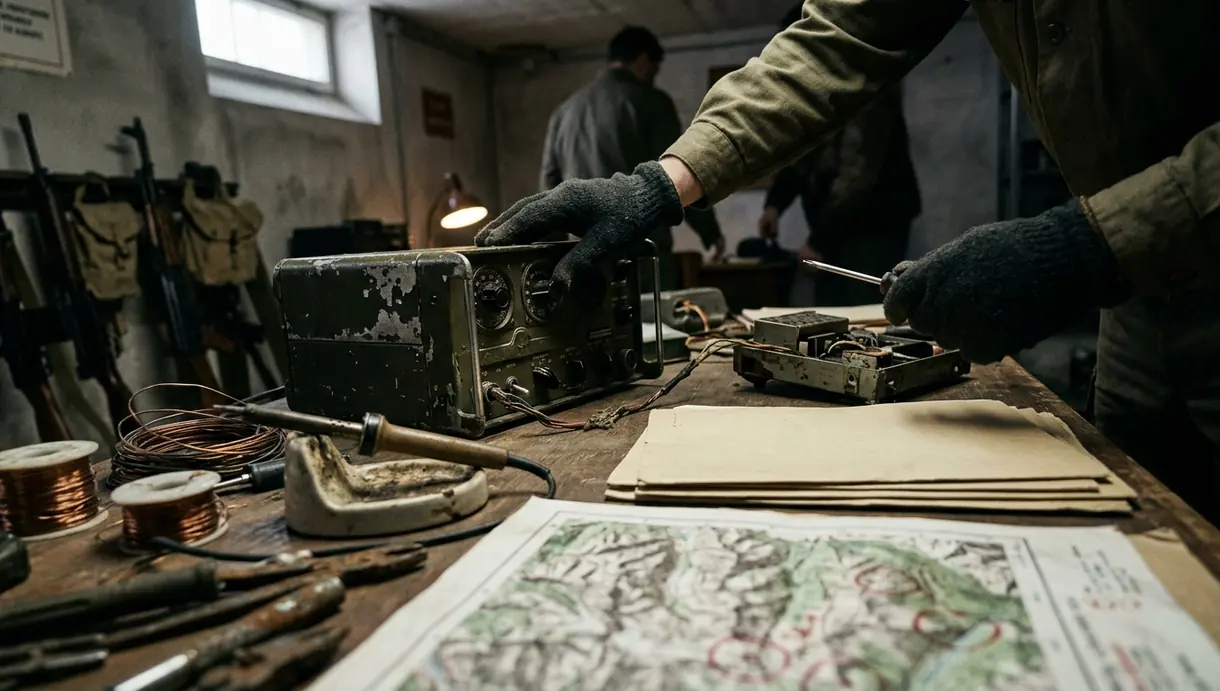
Logisticians selected sites that remained accessible after an occupation but appeared unlikely to be disturbed in peacetime. They sealed equipment against moisture, concealed it underground or inside structures, and indexed the location through records held apart from the field personnel who might eventually use it.
Caches Were Not Dead Drops
A concealed cache stored durable wartime matériel. A dead drop transferred messages, documents, money, or compact objects without requiring two agents to meet. Confusing the two obscures how compartmentation worked.
Italian records described 139 concealed arms sites, commonly called nasco caches. Later official accounting listed 127 as recovered and 12 as not recovered. That unresolved inventory is not a minor clerical point. It shows why researchers must trace custody records alongside the original placement files.
Reported Italian contents included small arms, ammunition, grenades, demolition material, knives, mortars, recoilless weapons, binoculars, and radio equipment. C-4 appears in judicial and intelligence discussions connected to particular cases, but the record does not support treating it as the standard explosive in every European cache.
Note: Claims about gold coins or emergency currency need a branch-specific inventory or financial document. Portable funds fit escape-and-evasion planning, yet surviving Italian cache summaries do not establish gold as universal equipment.
Coded radio schedules and separated contact chains added another barrier between personnel, matériel, and command. Even so, physical concealment had a structural weakness. After a cache was discovered near Trieste in February 1972, Italian authorities began recovering or relocating stores. One fixed site had exposed an inventory trail that secrecy procedures were supposed to protect.
How the Strategy of Tension Manipulated Public Perception
The “Strategy of Tension” describes a political mechanism: violence produces fear, fear narrows public tolerance for dissent, attribution identifies an enemy, and the resulting pressure expands support for coercive state action. It should be treated as an analytical and political label, not as the established title of a single NATO command plan.
In Italy, the most heavily investigated period runs from the late 1960s through 1980. Courts and parliamentary inquiries documented attacks by neo-fascist militants, false investigative leads, protected suspects, and misconduct by individual police or intelligence officials in specific proceedings. Those findings expose institutional protection and manipulation without automatically proving one uninterrupted chain of command.
What Makes an Operation a False Flag?
Incorrect early reporting is not enough. Initial accounts often reflect confusion, poor evidence, or political haste. A defensible false-flag finding needs stronger indicators: advance tasking, deliberately planted or suppressed forensic material, controlled attribution to an uninvolved group, payments or communications linking perpetrators to handlers, or coordinated political exploitation after the attack.
The public mechanism matters as much as the clandestine act. An attack becomes politically useful when officials, aligned media outlets, and interested organizations converge on an accusation before the evidence has matured. That convergence may result from coordination, shared ideology, or simple imitation. The timing alone cannot identify the cause.
Italian investigations found contacts among intelligence officers, extremist groups, clandestine political lodges, and organized-crime figures. The surviving record does not reduce those relationships to a stable hierarchy operating identically in every incident. The defensive stay-behind mission and domestic anti-communist activity occupied parts of the same institutional environment, but documentary proof of a centrally authorized Gladio role in individual bombings remains uneven.
How Investigators Uncovered the Secret Network
The exposure began with physical evidence. The concealed arms site found near Trieste in 1972 created records: inventories, recovery decisions, routing notes, and references to officials who knew where the equipment came from.
During the 1980s, magistrate Felice Casson reopened the investigation into the 1972 bombing. His inquiry, developed from 1984 through 1990, established that a far-right militant had committed the attack rather than the left-wing suspects suggested during the original investigation. Following that trail brought the wider stay-behind structure into view.
From Secret Files to Parliamentary Record
Prime Minister Giulio Andreotti acknowledged the organization to a parliamentary commission in August 1990. His government supplied a fuller report dated 18 October, and public disclosure followed later that month. On 22 November 1990, the European Parliament adopted a resolution condemning clandestine military networks that had escaped adequate democratic control and called for member-state investigations.
The Italian government then provided parliamentary authorities with a list of 622 Gladio members in 1991. The roster established formal participation in the contingency organization. It did not establish that every listed person knew of, supported, or participated in domestic political violence.
Note: Treating the 622-person roster as a catalogue of terrorists collapses organizational membership and criminal culpability into the same category. A crime requires evidence tied to the person, incident, instruction, and chain of custody.
Investigators also faced state-secrecy claims, incomplete indexes, delayed disclosure, missing files, and disputes over which service controlled particular records. Reports of destroyed archives or suspicious witness deaths carry evidentiary weight only when attached to named files, autopsy findings, or judicial determinations. Suspicion can direct an inquiry; it cannot complete one.
How to Trace Gladio’s Blueprint in Modern Geopolitics
Can Gladio help explain contemporary intelligence and conflicts, proxy operations, or manufactured domestic crises? Partly, but only if it functions as a comparison model rather than a template imposed on every suspicious event.
Start by separating actors according to function: sponsors, intermediaries, operational personnel, propagandists, institutional protectors, and political beneficiaries. These roles may overlap, but analysts should not merge them without authenticated communications, financial records, tasking documents, or custody evidence.
Track Operations and Narratives Separately
For a contemporary case, preserve official statements and original media artifacts at four intervals: the first 24 hours, days two through seven, days eight through 30, and after the first formal inquiry. Changes can expose corrections, synchronized language, or unsupported assertions. They do not explain why those changes occurred.
Build a separate operational ledger for concealed funding, cut-outs, unexplained access to restricted matériel, foreknowledge, evidence tampering, protected suspects, synchronized messaging, and policy proposals prepared before investigators established the facts.
Digital psychological warfare can now reproduce the fear-and-attribution stage without a traditional paramilitary cell. Relevant material includes original file metadata, platform archives, advertising disclosures, domain-registration history, bot-like publication timing, leaked tasking documents, and payment records. Cold War cells depended on radios, couriers, caches, and sabotage training. Modern influence networks may use compromised accounts, synthetic media, data theft, covert advertising, and proxy publishers.
Quick Tip: Create two timelines for the same event. Put physical acts and custody evidence in one; public claims and policy responses in the other. Connect them only when a document, payment, communication, or identified intermediary supports the link.
Resemblance to Gladio is not proof of state direction. Without authenticated tasking, financial, communications, or custody records, the comparison remains a hypothesis rather than an attribution.
How to Access and Analyze Declassified Archives
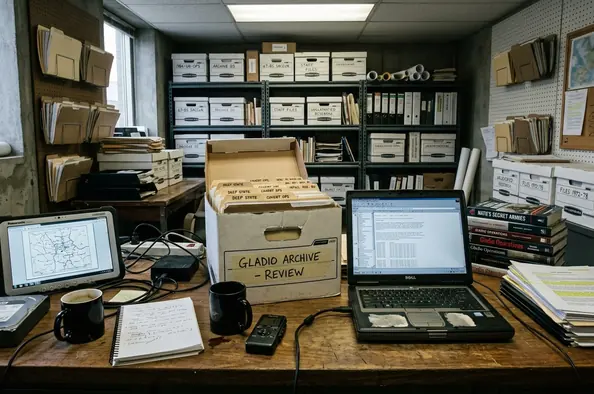
Do not search an archive for a complete conspiracy narrative. Start with a person, committee, office, date range, or document title narrow enough to produce a traceable record set.
- Open the CIA Freedom of Information Act (FOIA) Electronic Reading Room.
- Run exact-phrase searches for “stay-behind,” “stay behind,” “Allied Clandestine Committee,” “Clandestine Planning Committee,” “Gladio,” “SIFAR,” “SISMI,” “Capo Marrargiu,” and “Strategy of Tension.”
- Search “ACC” or “CPC” only with a country, office, or date because both abbreviations produce unrelated material.
- Begin with a 1948–1991 range, then narrow the results into five-year blocks. Search creation dates and public release dates, since later summaries may describe earlier operations.
- Record the title, creation date, originating office, recipients, document reference, redaction markings, and relevant page numbers for every useful file.
- Inspect each scan page by page. Optical character recognition can misread faded type, handwritten routing notes, stamps, and foreign names.
Quote the scanned image rather than the generated text, and compare duplicate releases because separate copies of the same memorandum may contain different redactions. If a necessary record remains withheld, a focused FOIA request should identify the office, subject, date range, and known reference numbers. The statutory target for an initial determination is 20 working days, with a possible 10-working-day extension for specified unusual circumstances, though intelligence review and interagency referral can take longer.
Open the reading room now, search the exact phrase “Allied Clandestine Committee,” and log the first relevant document’s title, creation date, originating office, reference number, and page-level redactions.