What the UN Meditation Room’s History Establishes
A quiet space existed at United Nations headquarters by 1952. Five years later, Secretary-General Dag Hammarskjöld oversaw its redesign and published an explanation titled “A Room of Quiet.” Those dates matter because they give the Meditation Room a traceable history. They also set a limit on what its architecture can prove about Alice Bailey and the Lucis Trust.
The room’s iron-ore block, concentrated light and abstract mural invite interpretation. Lucis Trust writings offer a vocabulary of spiritual hierarchy and shared human purpose that some readers see reflected there. The resemblance deserves scrutiny, especially in an institution better known for resolutions than contemplation. Yet an image shared by two traditions cannot tell us who proposed a design.
Hammarskjöld’s text is the starting point. It records the meaning he publicly assigned to the room in 1957. A stronger claim—that the Trust supplied its spiritual blueprint, would need evidence connecting Bailey or her organization to the design decisions. The distinction is consequential: one account describes the UN’s stated purpose for a room; the other proposes an undisclosed source for it.
How Bailey’s Publisher Became Part of This Question
Alice Bailey’s publishing organization began in 1922 as the Lucifer Publishing Company and adopted the Lucis name in 1925. Bailey published esoteric teachings that described a spiritual hierarchy, forms of energy and a “New Group of World Servers.” The latter phrase appeared in her writings before the Meditation Room’s 1957 redesign.
That chronology makes comparison possible. It does not establish contact with Hammarskjöld or the people responsible for the room. Bailey’s ideas were available before the redesign; availability is a different kind of evidence from a letter commissioning a mural or a record of a design meeting.
The organization’s later World Goodwill activity presents another line of inquiry. Its language of cooperation and service can sound familiar beside the public vocabulary of international institutions. Readers should ask what the Trust said in its own publications, then look separately for records of what it did in UN-associated settings. Combining those inquiries too early turns a textual parallel into an institutional claim.
Descriptions of the Trust’s UN standing also require precision. Consultative status at the United Nations is a term tied to particular bodies and recorded organizations; it should not serve as shorthand for every form of NGO access. A present-day status claim needs the listed entity and the relevant UN body identified. Even a confirmed listing would speak to participation, not authorship of a room redesigned decades earlier.
The Iron Block, the Light and Beskow’s Mural
The redesigned room gives a visitor few objects to interpret. A several-ton block of Swedish iron ore sits beneath a shaft of light. An abstract mural by Bo Beskow occupies the far wall. Their spare arrangement encourages symbolic readings, which makes Hammarskjöld’s own account especially useful.
He called the block an altar dedicated to the “God of all.” That phrase gives the room an expressly spiritual register while leaving it outside a single named religious tradition. The focused light and mural likewise belong to the setting he described as a room for quiet. Calling the block lodestone would add a physical property that the supplied record does not establish: iron ore is not necessarily magnetic.
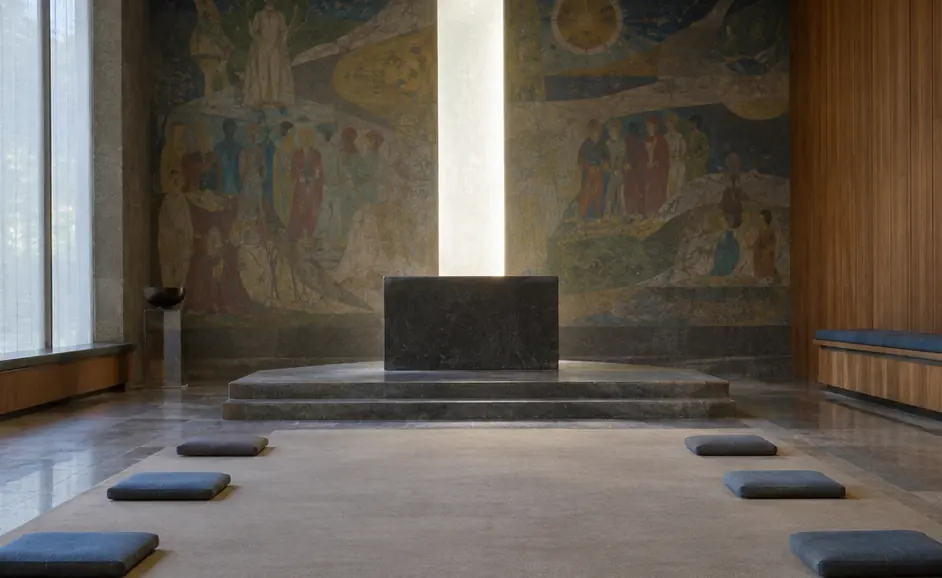
The mural poses a harder question. Its intersecting forms can be compared with esoteric imagery, including diagrams a reader may associate with Bailey’s teachings. But resemblance alone leaves open how Beskow arrived at the composition. A design record could show his references or instructions. Without one, the comparison remains an interpretation of the finished wall.
Three records that could settle the design claim
- Hammarskjöld’s explanation: Read “A Room of Quiet” for what he said the iron-ore block and light meant. It establishes his public account, not the source of every private suggestion.
- Beskow’s design record: Look for material showing how the mural’s geometry was chosen and whether a particular diagram informed it.
- Correspondence: Seek a traceable link between Bailey or the Trust and either architectural choice. A documented exchange would carry more weight than a visual parallel.
This sequence keeps the burden of proof where it belongs. The room’s spiritual character is visible in Hammarskjöld’s own language; a Lucis Trust blueprint remains a separate proposition.
Where Lucis Language Meets UN Participation
Bailey’s “New Group of World Servers” describes people engaged in service within her spiritual framework. International civil service also uses the language of service. Put the phrases side by side and a parallel appears. The next question is who used the language, in what setting, and to what effect.
World Goodwill offers a way to examine that question without treating all UN contact as the same thing. One can compare the Trust’s stated aims with a documented submission or contribution to a UN-associated forum, if such a record is available for the particular claim under review. Meeting records and cited contributions could show that an idea entered a discussion. NGO affiliation alone cannot show that officials adopted a doctrine.
The distinction grows sharper when the claim concerns policy. An argument that esoteric language influenced a specific UN decision would need a traceable route from a Trust contribution to the decision itself. A shared preference for cooperation or an evocative phrase supplies no such route. Documents produced for separate purposes may use similar words while meaning different things.
The boundary is clear: participation in UN-associated forums gives an organization opportunities to speak. It does not grant authority to draft legislation or set binding UN policy. The same caution applies to architecture: access to an institution and responsibility for one of its rooms are distinct claims, each requiring its own record.
For readers testing a broader claim about corporate agendas or hidden influence, this can feel unsatisfying. It is also useful. Naming the exact submission, meeting or design correspondence needed turns suspicion into a question that records might answer.
What the Room Leaves Open
The Meditation Room complicates a purely bureaucratic picture of the United Nations. Its 1952 precedent and 1957 redesign are documented, and Hammarskjöld chose spiritual language when explaining the redesigned space. The altar, light and mural belong in any account of what the UN chose to place inside its headquarters.
The available facts support that account more firmly than they support an esoteric origin story. Bailey’s writings predate the redesign, and their imagery can prompt close comparisons. They do not, on the evidence set out here, identify who directed Beskow or supplied Hammarskjöld with a design. Historical descriptions also say nothing certain about whether visitors can enter the room today.
Does Hammarskjöld’s altar express his non-denominational ideal, or can a primary-source link show that Bailey’s doctrine shaped its design?