Who Actually Commands the Bottlenecks of Global Trade?
Who holds the ultimate administrative veto when a sovereign nation's cargo is halted at a maritime transit corridor?
Authority is divided among canal administrations, customs and security agencies, terminal concessionaires, carriers, and insurers. Public records do not establish a general transfer of sovereign control to supranational entities or transnational asset managers. They reveal a more complicated problem: several institutions can interrupt a shipment, each exercising a different power.
Panama's canal administration operates under Panama's constitutional and statutory framework. Egypt's Suez Canal Authority administers the Suez Canal. A company holding a nearby terminal concession controls the rights its contract grants; that agreement does not confer authority over canal passage.
Long-term terminal leases, digital clearance systems, and environmental requirements deserve scrutiny because they shape access. But an investigation must establish who can issue a binding decision, which document authorizes it, and how the affected party can challenge it.
Break the chokepoint into five decisions: canal reservation, voyage underwriting, berth allocation, customs clearance, and terminal release. Then identify the authority and governing document for each.
This distinction matters when examining corporate agendas. A terminal operator may influence handling charges and berth availability while a customs authority retains cargo-release powers. Treating both as a single hidden command structure obscures the decision a shipper actually needs to contest.
The Suez and Panama Disruptions as Operational Stress Tests
From 23 to 29 March 2021, the Suez obstruction physically prevented through passage. During the Red Sea security diversions of December 2023–February 2024, the canal remained operational. Carriers instead reconsidered voyages through a dangerous approach. The resulting delays could look similar on a delivery schedule, yet their causes required different remedies.
Panama presented another problem: water availability. Canal authority advisories issued in October–November 2023 set scheduled daily transits at 24 from 7 November. That restriction concerned operating capacity, independently of who owned nearby container terminals.
What a Reservation Auction Actually Buys
For a carrier, the practical choices included securing an available reservation, competing for an auction opportunity, waiting, or changing the route. Panama's auction mechanism allocates particular reservation opportunities. It creates neither canal ownership nor a permanent passage entitlement.
Auction costs can strain a carrier with limited cash or scheduling flexibility. Establishing that smaller regional operators suffered disproportionately, however, requires matching results to vessel categories, transit dates, booking rules, and carrier circumstances. An expensive winning bid alone cannot establish an alliance-wide advantage.
The same discipline applies to Red Sea insurance. Investigators need dated additional-premium quotations, cancellation notices, geographic coverage, and exclusions. One vessel's quoted premium cannot represent an entire market.
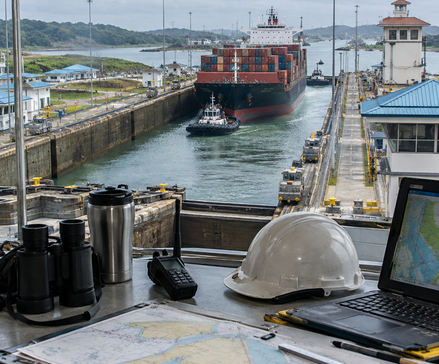
Private maritime intelligence providers supply tracking and threat assessments. Carriers and masters make routing decisions within charter, insurance, flag-state, and security requirements. Terminal operators influence berth availability and handling. Calling every participant a routing authority exaggerates some powers and conceals others.
AIS tracks can reconstruct reported movements and waiting patterns. They cannot establish which insurance exclusion or unpublished charter instruction caused a diversion. That part of the investigation requires documents beyond the vessel track.
Supranational Treaties and the Mechanics of Port Acquisitions
When does a terminal investment become a transfer of political leverage? Start with the rights transferred, then follow the money.
Piraeus offers a concrete starting point. Its container-terminal concession for terminals II and III was signed in 2008, with operations beginning in 2009 under a 35-year term. The concession text and Greek legislative ratification establish the operating rights. A beneficial-ownership inquiry requires a separate examination of shareholders and intermediate holding companies.
The Horn of Africa supplies a different legal record. Djibouti terminated the Doraleh container-terminal concession in February 2018. That concession, signed in 2006 for a 30-year term, subsequently generated arbitration and enforcement litigation. Those proceedings document contested concession rights and state intervention; they do not automatically establish a surrender of sovereignty.
In the Caribbean, Jamaica signed the Kingston Container Terminal concession in April 2015 for 30 years, with operating handover on 1 July 2016. Port Authority of Jamaica reporting provides a trail between agreement and implementation.
Trace the Consideration Before Calling It Debt Relief
- Identify the public grantor, concessionaire, award procedure, operating term, and investment obligations.
- Separate equity purchases, concession fees, capital expenditure, and refinancing.
- For a claimed debt settlement, identify the creditor, debt instrument, consideration, and rights transferred.
- Read amendments and dispute records for changes to termination, tariffs, access, and state intervention.
These distinctions also discipline claims about dual-use facilities or extraterritorial logistics zones. Commercial operating rights alone establish neither military access nor immunity from domestic jurisdiction. The relevant agreement must support the claim.
Carbon Ratings Have Limits
The IMO Carbon Intensity Indicator requirements took effect on 1 January 2023. An E rating for one year, or D ratings for three consecutive years, triggers a corrective-action plan within the ship's energy-efficiency management plan. The rating itself creates no automatic worldwide passage prohibition.
The EU maritime emissions trading framework began applying on 1 January 2024, with surrender obligations phased in for emissions generated during 2024–2026. European legislation and administering authorities enforce it. Under the International Ship and Port Facility Security Code, governments establish security levels; the code creates no universal private score allocating canal slots.
The Sovereign Cost of Automated Supply Chain Governance
A cargo can reach port and still remain beyond its buyer's reach. Consider a grain shipment moving from berth reservation through manifest submission, customs clearance, terminal release, and inland delivery. Each stage has a potential stop, and each stop has its own decision-maker.
An unavailable berth delays discharge. A customs hold prevents cargo release after unloading. A terminal payment hold can prevent gate release. For an importer facing dwindling stocks, these distinctions determine which institution can resolve the delay.
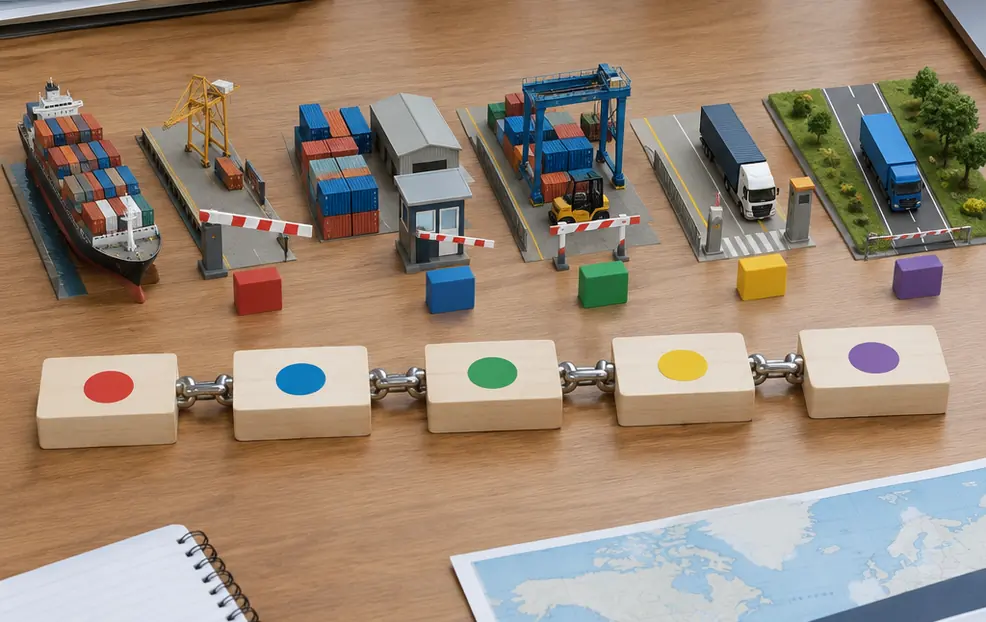
A port community system exchanges operational information among participating users. A customs single window supports submissions to public authorities. The IMO amendments requiring maritime single windows took effect on 1 January 2024; they did not establish an IMO-operated global customs clearance service.
EU Import Control System 2 maritime deployment for carriers ran from 3 June to 4 December 2024, followed by deployment windows for other maritime participants during 2024–2025. Its entry summary declarations support pre-arrival safety and security analysis. To investigate a hold, establish which authority acted and what rule it applied before attributing the decision to software.
| Mechanism | Point of pressure | Evidence to obtain |
|---|---|---|
| Naval coercion | Interception, threat, or physical exclusion of vessels | Orders, notices, and documented encounters |
| Customs or sanctions action | Permission to move or release cargo | Issuing authority, legal basis, and appeal route |
| Insurance or certification | Conditions under which a voyage proceeds | Policy terms, exclusions, or certificate requirements |
| Terminal access | Berthing, handling, or gate release | Concession, tariff, service terms, and hold notice |
Administrative interruption can produce blockade-like consequences for a shipment without constituting a naval blockade. National exposure requires further evidence: dated inventories, replenishment schedules, alternative-port capacity, and inland transport. Grain and fuel cargoes impose different handling requirements and cannot share an assumed resilience outcome.
Auditing the Future of Sovereign Maritime Access
Choose one terminal and build a dated evidence file. A focused record will expose more than a collection of acquisition headlines.
- Recover the operating agreement. Search port-authority concession registers, annual reports, procurement notices, national official gazettes, and parliamentary ratification records. Include extensions and amendments.
- Trace control separately. Compare company-register filings, securities disclosures, and consolidated accounts. IMO GISIS and Equasis support ship and maritime-company identification; terminal ownership needs contractual and corporate records.
- Check when rules became binding. Compare the IMO's Status of Conventions and relevant UN Treaty Collection entries with domestic legislation. Adoption, entry into force, and implementation are different events.
- Preserve voyage-specific rules. Archive Panama Canal Authority advisories and Suez Canal Authority navigation circulars with their versions and effective dates. For European environmental measures, compare EUR-Lex texts, Commission guidance, and national enforcement notices.
- Classify disputes accurately. Distinguish allegations, interim orders, final awards, and enforcement judgments. Access-to-information rights depend on the public body covered; arbitration confidentiality depends on the applicable contract, rules, and publication decisions.
References
The records above establish individual rights and restrictions. For broader transport context, consult the UNCTAD Review of Maritime Transport.
Before the next supply shock, will your nation's leadership secure enforceable access and a clear appeal route for essential cargo, or leave those decisions to contracts and systems it cannot direct?