Mainstream accounts usually place DARPA in the safe museum of American invention: packet switching, satellite navigation, robotics competitions, and the occasional strange machine that makes good television. That version is not false. It is incomplete.
The more revealing record starts in February 1958, when ARPA was created inside the U.S. Department of Defense after the Soviet satellite shock of October 1957. The assignment was blunt: prevent technological surprise by initiating it. Once that sentence is taken seriously, the familiar civilian spin-off story begins to look less like the center of the agency and more like exhaust from a military engine.
Note: The evidence window here runs from 1958 through the early-to-mid 2010s. Patents, solicitations, and prototypes prove research direction and technical ambition; they do not by themselves prove worldwide operational deployment.
In this Article
- The Blueprint for Total Spectrum Dominance
- The Illusion of the Civilian Spin-Off
- Weaponizing the Biosphere: From Acoustic Kitty to Cyborg Beetles
- The Omnipresent Eye: Persistent Surveillance Architectures
- Engineering the Heavens: HAARP and Orbital Optics
- The Black Budget Horizon: What Remains Hidden
- Conclusion: The Architecture of a Controlled Future
The Blueprint for Total Spectrum Dominance
What does a research agency build when its founding fear is surprise?
Not just better weapons. It builds early warning, perception, pursuit, biological interface, command networks, and ways to extract meaning from human behavior before an adversary can act. The public record does not hand researchers one master plan stamped with a dramatic title. It offers something more workmanlike: a procurement pattern that repeats across decades.
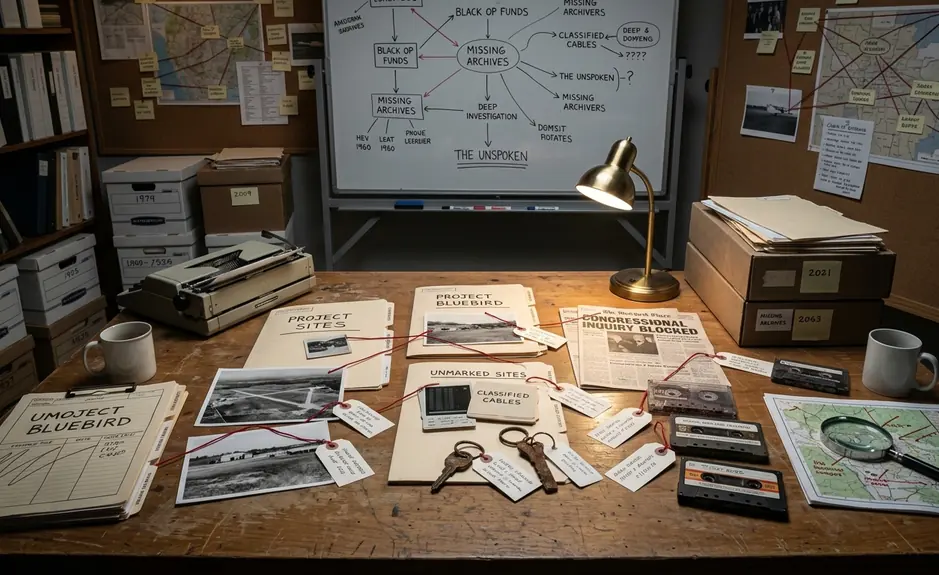
From networked command systems in the 1960s to data-mining proposals in 2002 and 2003, then persistent wide-area imaging demonstrations publicized in the early-to-mid 2010s, the arc points toward total spectrum dominance during comparative review. That phrase sounds theatrical until it is broken into its plain pieces: see more, decide faster, track longer, and shape the environment in which a target can move.
The pattern matters more than the slogan
Declassified records and public solicitations show interest in remote sensing, autonomous pursuit, human-machine interfaces, biological platforms, and information extraction. Each project can be described as narrow. Together, they suggest an operating philosophy that treats privacy, distance, terrain, and even biology as technical barriers.
The partial answer, then, is not that every DARPA concept becomes a hidden operational system. Many do not. The stronger conclusion is that the agency has repeatedly explored the machinery of comprehensive control long before the public sees a civilian explanation for the same underlying tools.
The Illusion of the Civilian Spin-Off
Consider ARPANET. Its first four-node network went live in 1969, linking research sites through packet switching developed under defense sponsorship. In public memory, this becomes a warm origin story about the internet. In the original setting, it was a command-and-research problem: how to move information through resilient networks.
GPS followed a similar path. It began as a U.S. military satellite-navigation system in the 1970s. Full operational capability arrived in the mid-1990s, and broad civilian reliance accelerated after selective degradation ended in 2000. The phone in a delivery driver’s hand is real. So is the targeting logic that came first.
Useful does not mean innocent
ARPA became DARPA in 1972, reverted to ARPA in 1993, and returned to DARPA in 1996. The name changed; the operating logic remained. The agency’s recurring phrase, 'prevent and create technological surprise,' says more than the later celebration of civilian benefits.
The implication is uncomfortable but practical. Civilian usefulness can launder public perception. A tool that helps families navigate a highway may also refine military movement, timing, and strike coordination. The benefit is not imaginary. It is simply not the whole story.
Quick Tip: When evaluating a celebrated spin-off, start with the defense problem it originally solved. The origin often explains the architecture better than the consumer use case.
Weaponizing the Biosphere: From Acoustic Kitty to Cyborg Beetles
The biological record should be handled in layers, because sloppy claims weaken the real case.
Acoustic Kitty was a 1960s CIA project that surgically implanted listening equipment into a cat. Public accounts place the effort in the early-to-mid 1960s and describe it as operationally unsuccessful. It supports a history of intelligence experimentation on animals, but it should not be presented as a confirmed DARPA operation without a source tying DARPA directly to that project.
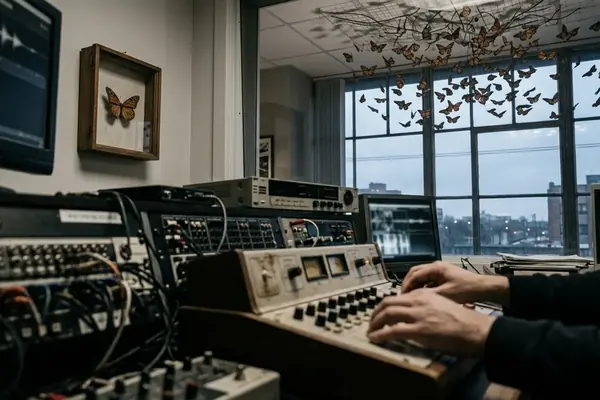
The DARPA evidence becomes clearer in 2006, when the agency publicly solicited work under Hybrid Insect Micro-Electro-Mechanical Systems. The idea was not metaphorical. Researchers explored implanting devices during insect metamorphosis so adult insects could carry sensors or be steered.
The beetle as platform
Published beetle-control demonstrations from the late 2000s and early 2010s used implanted electrodes to stimulate flight muscles or neural structures in large flower beetles, including Mecynorrhina torquata. This is where the case moves from folklore to engineering. The animal becomes a carrier, an actuator, and a living airframe.
The same section of history includes MEDUSA, a concept active in public descriptions around 2007 and 2008. It relied on the microwave auditory effect, where short microwave pulses can produce perceived clicks or tones through thermoelastic expansion in tissue. Popular retellings jump to voices beamed into skulls. The public technical description supports perceived sound effects, which is already unsettling without embellishment.
The broader principle is simple: once biology is treated as an interface, the boundary between organism and instrument starts to erode.
The Omnipresent Eye: Persistent Surveillance Architectures
ARGUS-IS is the cleanest surveillance case because its public specifications do much of the work. Reporting confirms that the system was described in 2013 as a 1.8-gigapixel airborne wide-area imaging platform capable of recording roughly 12 frames per second over a city-scale area.
That number is not just a bragging point. It changes the job of surveillance. Instead of following one suspect with one camera, analysts could open many separate video windows from the same wide-area feed and review multiple locations inside one collection zone.
From watching people to replaying cities
In the older model, a camera had to be pointed correctly at the right time. In the ARGUS-IS model, the field itself becomes an archive. Movement can be traced backward. Meetings can be reconstructed. Routes can be compared.
Total Information Awareness, run under DARPA’s Information Awareness Office in 2002 and 2003, supplied the informational counterpart. Congress publicly defunded it in 2003 after civil-liberties objections, but the concept left a deep impression: large-scale data-mining as a national-security tool.
Then there is Multi-Robot Pursuit work from the late 2000s, which studied how teams of robots could cooperatively track and pursue a non-cooperative human target in complex terrain. Put the three ideas together and the architecture becomes clearer: wide-area sensing, data extraction, and autonomous pursuit.
There is a limit. ARGUS-IS-style surveillance fits open urban or semi-urban movement tracking better than indoor spaces, dense underground environments, or areas with persistent visual obstruction. The system is powerful precisely where the sky can see.
Engineering the Heavens: HAARP and Orbital Optics
Can an ionospheric research facility be discussed without sliding into fantasy?
It can, and it should. HAARP was built in Alaska during the 1990s as a high-power ionospheric research facility. Its main instrument is a phased array used to heat small regions of the ionosphere for controlled experiments. That statement is narrower than weather-control folklore, but it still describes a serious capability: deliberate perturbation of part of Earth’s upper atmosphere for study.
The patent record adds another layer. Patent #4,686,605, issued in August 1987, describes a method and apparatus for altering a region in Earth’s atmosphere, ionosphere, or magnetosphere using electromagnetic radiation. A patent is not a deployment order. It is evidence of technical imagination, legal positioning, and research direction.
From atmosphere to orbit
DARPA’s MOIRE program, publicly active in the early 2010s, moved the question upward. It pursued large membrane-based diffractive optics for geosynchronous-orbit imaging concepts. Public material described a shift away from heavy glass mirrors toward lightweight deployable membrane optics, with the aim of creating much larger orbital apertures than conventional spacecraft optics allowed.
The narrower answer is that environmental and orbital systems deserve separate treatment. HAARP concerns controlled ionospheric experiments. The patent concerns proposed atmospheric alteration methods. MOIRE concerns orbital imaging. Together, they show an appetite for operating at scales that ordinary civilian technology rarely touches.
The Black Budget Horizon: What Remains Hidden
The strongest public case rests on documents that can be checked: declassified records, patent filings, budget references, solicitations, public demonstrations, and disclosed test results.
A publicly discussed 2012 test of a 10-kilowatt-class laser module shows that directed-energy work had reached testing or prototype maturity in at least some disclosed lines by the early 2010s. That does not reveal the current classified edge. It tells researchers that by the time a system appears in open discussion, the underlying work may already have a long institutional history.
The edge of the map
Special Access Programs and classified budget compartments prevent outside researchers from confirming the current state of the most sensitive systems through ordinary public records. That is not a loophole in the analysis. It is the condition under which this subject must be studied.
Comparisons demonstrate the value of staying close to the paper trail. The public evidence does not prove every rumored platform. It does show recurring investment in sensing, autonomy, bio-interfaces, orbital observation, and directed energy across a defensible timeline.
Researchers should resist both temptations: official reassurance that every program is harmless, and internet certainty that every concept has already been deployed everywhere. The harder work sits between those poles.
Conclusion: The Architecture of a Controlled Future
DARPA’s portfolio is not a random cabinet of scientific curiosities. Read across the 2006 to 2015 window, the convergence is hard to miss: insect-machine interfaces, wide-area airborne imaging, autonomous pursuit, legged robotics, membrane-orbital imaging, and directed-energy disclosures were all publicly visible.
LS3, the robotic mule publicly demonstrated during 2012 to 2015 testing, makes the point in a grounded way. It was designed to carry roughly 400 pounds of gear for a squad over rough terrain. Public reporting later described it as too noisy and maintenance-heavy for some field use. That does not make the project irrelevant. It shows how a prototype can be technically impressive and still struggle to transition cleanly into the field because of noise, maintenance burden, or tactical mismatch.
This matters because the architecture is not only about finished products. It is about direction. Autonomous robotics reduce dependence on human carriers. Persistent surveillance turns movement into stored evidence. Biological interfaces test whether living systems can be recruited into machine networks. Orbital optics stretch observation from the local to the planetary.
Summary: The public record does not prove a single hidden master system. It does reveal a long-running pattern of research aimed at seeing farther, tracking longer, automating pursuit, and extending control into biological and environmental domains.