Redrawing the Middle East: Geopolitical Projects and Resource Wars
Discover how constructive chaos and balkanization are redrawing Middle East geopolitics. Explore the rise of Greater Kurdistan and regional resource wars.
The phrase “constructive chaos” sounds like a contradiction until it is placed beside the policy record of the mid-2000s. The point was not that every militia commander, border clash, or cabinet collapse answered to a single switchboard. The point was sharper: disorder became useful when it weakened unitary states, loosened control over energy corridors, and made old borders look negotiable.
The decision trail runs through public language and sequencing, not through a neatly signed master plan. In July 2006, during the Lebanon crisis, Condoleezza Rice described the violence as the “birth pangs of a New Middle East.” One month earlier, Ralph Peters published the “Blood Borders” map in Armed Forces Journal, proposing altered frontiers for Iraq, Syria, Saudi Arabia, Turkey, Iran, and a larger Kurdish state. Those were not fringe years. They followed the 2003 Iraq invasion, the 2003-2005 work of the U.S. occupation authority around federal constitutional design, and Iraq’s October 2005 constitution, which institutionalized a federal model instead of a unitary one.
Note: The balkanization thesis is strongest as an interpretation of incentives, policy choices, and repeated outcomes. It weakens when presented as a fully documented, centrally commanded border-redrawing plan.
That caveat matters. Serious analysis does not need theatrical certainty. Recent regional conflicts can be read as engineered balkanization because outside powers repeatedly favored arrangements that broke state sovereignty into smaller, more dependent pieces. Yet the mechanism was rarely a formal partition decree. It was pressure: constitutional design, sanctions, proxy patronage, air campaigns, pipeline pressure, and narrative control.
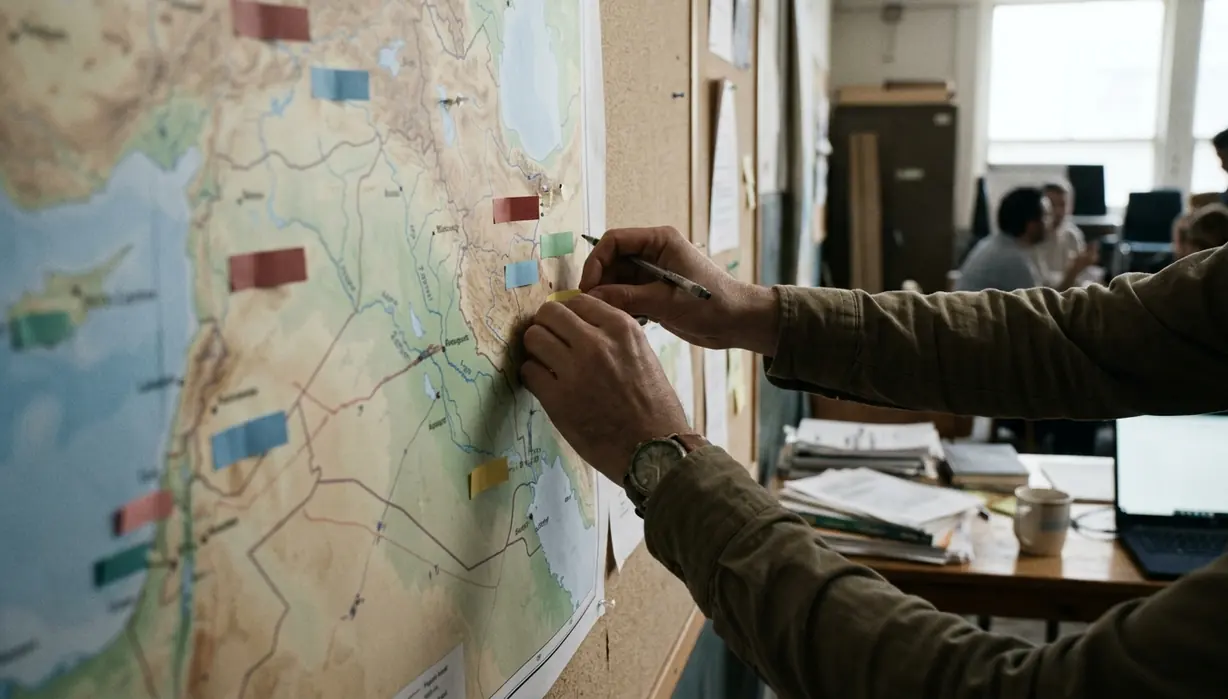
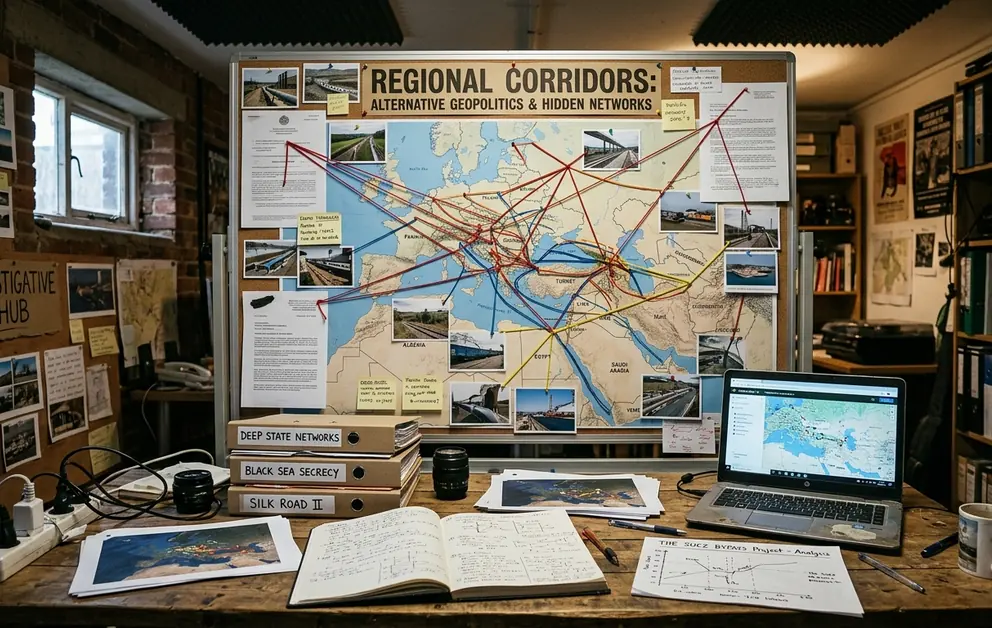
Energy routes, armed corridors, and proposed border changes often overlap; the geography is not incidental.
Greater Kurdistan: The Geopolitical Linchpin
Kirkuk is the better entry point than theory.
In June 2014, as Iraqi federal forces withdrew during the northern Iraq collapse, the Kurdistan Regional Government gained de facto control over Kirkuk. That single move joined identity politics to export infrastructure. The KRG-backed route through Turkey connected Kurdish-controlled fields to the Mediterranean outlet at Ceyhan, turning the northern Iraq-Turkey line into the hard asset behind the Baghdad-Erbil revenue dispute from 2014 through 2023.
Greater Kurdistan, in that context, was not just a nationalist map. It was a corridor system. A Kurdish actor controlling territory across northern Iraq and influencing adjacent Kurdish zones in Syria could interrupt the older state logic of Baghdad and Damascus. It could also offer outside powers a partner whose autonomy depended on external recognition, market access, and security guarantees.
Pipeline Autonomy and Political Exposure
The Kurdish independence referendum on 25 September 2017 showed both the reach and the fragility of that project. The vote sought to convert battlefield gains into diplomatic fact. Iraqi federal forces retook Kirkuk on 16 October 2017. In less than a month, the core asset behind the independence bid changed hands.
Tracking data indicates that the northern export route remained central even after the referendum failed to produce a recognized state. Oil flows through the Iraq-Turkey route were halted on 25 March 2023 after an international arbitration ruling favored Baghdad’s authority over exports. That ruling did what several speeches could not: it exposed how much Kurdish autonomy rested on the legal and commercial status of one route to Ceyhan.
Covert intelligence operations around Kurdish autonomy are harder to document cleanly than pipeline interruptions. That is the nature of liaison politics. Still, the visible pattern is clear enough for field analysis: border access, militia coordination, selective diplomatic protection, and energy brokerage shaped Kurdish bargaining power as much as formal constitutional language did. The implication is blunt. Fragmenting Iraq and Syria did not require immediate recognition of a new Kurdish state. It required a Kurdish zone strong enough to weaken the states around it, but not always strong enough to escape dependence.
Weaponizing Sectarianism: Operation Libya and the Syrian Proxy War
What made Libya a template rather than merely a precedent?
The answer begins with the chain of intervention decisions. The Libya campaign followed the 17 March 2011 Security Council authorization. The air campaign ran from 19 March to 31 October 2011, degrading the Libyan state’s command structure under the language of civilian protection. Once the center fractured, Libya’s state oil company and foreign energy contracts became bargaining points for transitional authorities during 2011-2012 as production and export terminals changed hands. ENI and other foreign energy interests did not need to write the political script to benefit from access politics after the state apparatus broke apart.
“Operation Libya,” as an analytical shorthand, matters because it joined moral language to material consequences. Civilian protection opened the door. Command disruption changed the balance. Oil infrastructure then became a prize negotiated through armed and transitional channels.
From Air Campaign to Proxy War
Syria presented a harder target. The Free Syrian Army announced itself in July 2011. Al-Nusra publicly emerged in January 2012 and was later designated by Washington as a terrorist organization in December 2012. The battlefield did not divide neatly into democratic opposition and regime loyalists; it became a crowded proxy environment where foreign-backed militias, ideological formations, intelligence services, and local factions competed for routes, towns, and legitimacy.
NATO approved Patriot missile deployment to Turkey on 4 December 2012, and batteries became operational near the Syrian border in January 2013. That deployment did not by itself create a no-fly zone. It did, however, thicken the military perimeter around Syria at the same time external actors debated the conditions for deeper intervention.
The chemical-weapons narrative added another layer. After the 21 August 2013 attack near Damascus, the United States and Russia reached a disarmament framework in September 2013, followed by the declared removal of Syria’s chemical stockpile by mid-2014. The partial answer is that Syria did not reproduce Libya because the Syrian state core survived, foreign allies stayed committed, and the intervention narrative met counter-pressure before it could become a clean regime-collapse instrument.
Quick Tip: When comparing Libya and Syria, watch the state core. Oil terminals can change hands quickly; security institutions with external backing can make collapse far more costly.
The Ultimate Target: Iran and the Energy Corridors
The encirclement of Iran is best understood through routes before rhetoric. Speeches about threats matter, but pipeline maps show why Iraq, Syria, the Gulf, and the eastern Mediterranean sit in the same strategic file.
In July 2011, Iran, Iraq, and Syria signed a gas-pipeline framework intended to move Iranian gas westward from South Pars through Iraq toward Syria. The route would have linked Tehran to an east-west energy corridor through states not aligned with U.S. preferences. A different energy geography favored routes that bypassed Iran or diluted its ability to move gas west under its own political cover.
The Iran-Pakistan gas pipeline agreement, signed in 2010, tells the same story from another direction. Iran advanced construction on its side. Pakistan’s section remained delayed under financing and sanctions pressure during 2013-2024. Sanctions here were not only punishment. They shaped infrastructure by deciding which corridors could attract capital and which corridors would sit unfinished.
Military Hardening Along the Same Map
The military layer developed in parallel. The United States began fielding the GBU-57 Massive Ordnance Penetrator in the early 2010s, with later upgrades aimed at hardened underground targets. Iran, meanwhile, opened and expanded naval facilities on the Gulf of Oman and Makran coast from 2008 through the early 2020s, reducing reliance on bases inside the Strait of Hormuz.
Comparisons demonstrate the symmetry. Washington hardened the strike option against buried infrastructure. Tehran hardened its maritime posture beyond the most predictable chokepoint. Neither move can be separated from energy corridors, sanctions pressure, and the geography of deterrence between 2010 and 2024.
This is where the Levant’s fragmentation connects to Iran. A weakened Syria complicates Iranian access westward. A fragmented Iraq gives outside powers more pressure points along the land bridge. Kurdish autonomy, Gulf naval posture, sanctions enforcement, and proxy war all become parts of a single strategic contest over movement: gas, weapons, money, and political influence.
The Limits of Imperial Geography
Maps drawn in policy journals and war rooms keep running into men with rifles, parties with rival memories, and states that do not always collapse on schedule.
The 2017 Kurdish referendum is the cleanest failure case. It produced a rapid federal response: from the 25 September vote to the 16 October Iraqi operation, Kirkuk shifted back under federal control within three weeks. That did not erase Kurdish autonomy. It did show that a border-changing move could be reversed by local and federal coercive power before outside recognition hardened around it.
Libya offers a different warning. After 2014, rival governing authorities and competing armed coalitions showed that the 2011 intervention did not produce a stable, externally manageable order. Fragmentation opened access points, but it also multiplied veto players. A broken state is not the same as a controlled state.
Syria complicates the template further. Government forces, backed by foreign allies, retook major urban corridors during 2016-2018, limiting the feasibility of regime-collapse planning. Iraq’s militia politics after 2014 created armed actors that were neither fully controlled by Baghdad nor by outside patrons. This is the part of the story neat imperial geography usually misses: proxies learn, defect, bargain, and build their own economies of violence.
Bottom line: External powers can encourage balkanization, weaponize sectarian fear, and pressure energy corridors. They cannot reliably determine the final political shape once local actors convert chaos into their own bargaining power.
The Middle East has not been redrawn in one formal act. It has been stressed, segmented, and repeatedly tested at its seams. The deeper question is not whether every conflict was scripted from outside. It is whether repeated interventions made fragmentation more likely, then treated the resulting disorder as a strategic opening. On the evidence available, that question deserves a harder answer than official narratives usually allow.