In this Article
- Executive Summary: The Shift from Gold to Black Gold
- The Official Narrative vs. Geopolitical Reality
- The 1971 Nixon Shock: Setting the Stage
- Engineering Scarcity: The 1973 Embargo Examined
- The Mechanics of the US-Saudi Petro-Dollar Pact
- Scope and Limitations of the Petro-Dollar Theory
Executive Summary: The Shift from Gold to Black Gold
The 1970s oil crisis looks different when the sequence is kept intact. First, the dollar lost its direct gold convertibility. Then oil prices moved violently upward. Finally, exporter surpluses returned through dollar deposits, government securities, and loans to states suddenly short of energy cash.
That chain matters because it changes the question. The useful question is not whether the embargo was real. It was. The question is whether the crisis also acted as a transition mechanism for a reserve currency no longer anchored to gold.
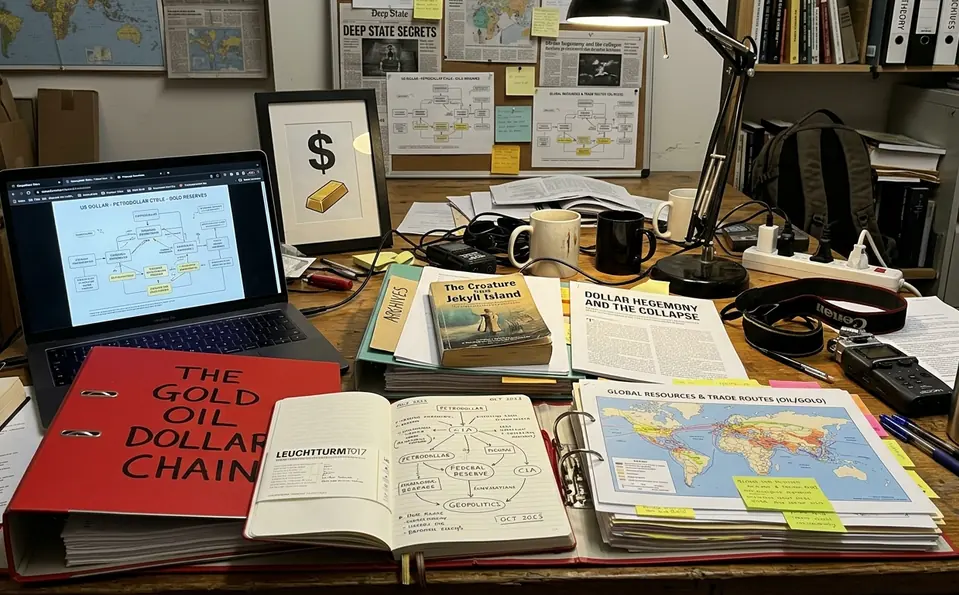
On 15 Aug 1971, the United States suspended direct gold convertibility for foreign official dollar holders. On 18 Dec 1971, a multilateral realignment reset the official gold price from $35 to $38 per troy ounce. By 19 Mar 1973, major currencies were operating under generalized floating exchange rates. The monetary floor had already cracked before the first winter gasoline queues became television theater.
Then came the energy shock. From Oct 1973 to Mar 1974, Arab oil restrictions and production cuts coincided with a key Gulf crude posted price moving from $2.90 per barrel before Oct 1973 to $11.65 per barrel in Jan 1974, per documented metrics. Between 1974 and 1981, oil-exporter surpluses commonly recycled through dollar bank deposits, government securities, and loans to deficit oil-importing states. Physical crude moved one way; financial claims moved another.
Summary: The petro-dollar argument is strongest when treated as a financial architecture, not as a cartoon in which one meeting secretly controlled every barrel of oil.
The Official Narrative vs. Geopolitical Reality
Was the 1973 crisis simply punishment for Western support of Israel during the Yom Kippur War?
That is the clean classroom version. It has dates, villains, and a moral arc. Arab producers announced output cuts on 17 Oct 1973. Restrictions against the United States followed on 20 Oct 1973 after military resupply decisions. The embargo against the United States ended on 18 Mar 1974. The State Department’s own chronology, including declassified diplomatic cables regarding the 1973 oil embargo, confirms the diplomatic confrontation.
But a review of the crisis cannot stop at producer-state decisions. Four separate layers often get collapsed into one story: export restrictions by producer governments, price controls in consuming states, domestic allocation rules, and inventory behavior by integrated oil companies.
Reporting confirms that on 27 Nov 1973, a federal petroleum-allocation statute placed distribution decisions under administrative formulas during the winter shortage period. That changed who received product, when, and under what rules. Scarcity at a filling station could reflect missing crude, refinery scheduling, allocation formulas, retail rationing, or fear-driven purchasing. It did not automatically prove a literal global absence of oil.
Congressional energy-profit hearings in Jan-Feb 1974 examined crude pricing, inventory gains, transfer pricing, and foreign tax-credit treatment after major integrated oil firms reported sharply higher 1973 earnings. The old “Seven Sisters” system did not need to invent the crisis to benefit from it. It needed price leverage, opaque internal transfers, and governments too busy managing queues to inspect the full ledger.
Note: An article that treats gasoline queues as proof of a literal global shortage ignores domestic price controls, federal allocation formulas, refinery scheduling, and local retail rationing during winter 1973-1974.
The partial answer, then, is uncomfortable. The embargo was geopolitical retaliation, but the shortage experience was also administrative and commercial. One explanation does not cancel the others.
The 1971 Nixon Shock: Setting the Stage
Start inside the closed executive-level meetings of 13-15 Aug 1971. Foreign claims on US gold had become more than a technical nuisance. The fixed exchange-rate system was absorbing pressure from balance-of-payments stress, military spending, and external dollar holders asking whether paper promises still converted into metal.
The decision announced on 15 Aug 1971 bundled three measures: suspension of convertibility, a 90-day wage-price freeze, and a 10% import surcharge. It was not just a monetary adjustment. It was emergency statecraft.
The broader principle is simple enough to miss: reserve currencies depend on belief, but belief usually needs a settlement mechanism. Gold had supplied one. Once direct convertibility ended, the dollar needed another reason for foreign governments, central banks, and importers to hold it in large quantities.
Negotiated parity adjustments from Dec 1971 to Feb 1973 failed to stabilize the system. By March 1973, major currencies had moved into generalized floating. The oil embargo came more than two years after the convertibility break, so the currency problem was already active before the oil-price shock.
The fiat vacuum
Without a tangible backing asset, the dollar faced a credibility problem rather than an immediate mechanical collapse. Hyperinflation was feared by critics of the move, but the more precise threat was reserve-status erosion. If foreign holders no longer trusted gold redemption and did not yet see another anchor, they could reduce their dollar exposure.
Energy solved part of that problem because every industrial economy needed it. A universally demanded commodity could create structural dollar demand if priced, financed, and recycled through dollar channels. That is where the petro-dollar thesis gains force.
Engineering Scarcity: The 1973 Embargo Examined
The Yom Kippur War gave political cover to a price restructuring that would have been difficult to sell in peacetime. Scarcity did not arise from one valve turning shut. It formed through layers: producer restrictions, winter demand, federal allocation, controlled prices, and local queue management.

Oct 1973 to Mar 1974 overlapped with winter consumption, administrative allocation, and retail-level queues. On 2 Jan 1974, the federal 55 mph speed limit was signed as a conservation measure. On 6 Jan 1974, year-round daylight saving time began. In Jan-Feb 1974, several states used odd-even gasoline purchasing rules.
These measures taught citizens to experience the crisis physically: slower highways, altered clocks, assigned purchasing days, empty pumps, and long lines. Panic did not need fabrication. It needed repetition.
The price movement was sharper than the daily inconvenience suggested. A key Gulf crude posted price moved from $2.90 per barrel before Oct 1973 to $5.12 in Oct 1973 and $11.65 in Jan 1974. That roughly 400% increase functioned like a global tax on oil importers. Developing nations faced the harshest arithmetic: more dollars needed for fuel, fewer dollars available for development, and deeper dependence on external credit.
How panic amplified policy
Available reporting suggests that scarcity at the retail level reflected more than a physical supply cut. Allocation formulas redirected product. Price controls discouraged flexible adjustment. Local rationing concentrated fear into visible lines. Media images then converted local stress into national mood.
This was not a neat conspiracy machine. It was a crisis environment in which many actors had incentives to let shortage signals travel faster than logistical explanations.
The Mechanics of the US-Saudi Petro-Dollar Pact
What moved after the embargo was not only oil. Sovereign cash moved, and it moved through channels Washington understood well.
On 8 Jun 1974, a bilateral economic cooperation commission created working groups covering finance, industrial planning, technical assistance, and government-to-government coordination. This framework took emergency diplomacy and made it institutional. Security assistance and arms sales strengthened the bargain; financial management gave it durability.
During 1974-1975, Treasury officials arranged mechanisms for Saudi official purchases of US government securities, including handling that kept some holdings inside aggregate reporting categories rather than ordinary country-by-country disclosure. From 1974 to 1981, the main recycling channels were dollar deposits at international banks, purchases of US government securities, and syndicated loans to oil-importing states.
The practical effect was a loop. Oil importers needed dollars to buy energy. Oil exporters accumulated dollar surpluses. Those surpluses returned to dollar markets through deposits, securities, and loans. The dollar, detached from gold, gained a new form of support through energy settlement and capital recycling.
Key point: Follow the surplus, not just the shipment. Crude cargo explains energy dependence; recycled dollar claims explain financial dependence.
The treaty problem
Here the petro-dollar theory needs discipline. The archival record supports a security-finance bargain and dollar recycling more strongly than it supports a single public treaty compelling every oil exporter to price every cargo exclusively in dollars. The comparisons suggest that recycling was strongest for high-surplus Gulf exporters during 1974-1981, while other producers, importers, and barter-linked transactions did not fit a single uniform dollar-control model.
So the phrase “petro-dollar pact” works if it describes an operating system. It misleads if it suggests a simple signed document that controlled the entire world oil market without exception.
Scope and Limitations of the Petro-Dollar Theory
The petro-dollar framework explains a major part of US financial endurance after Bretton Woods. It does not explain every price movement of the 1970s.
US CPI-U annual average index values rose from 41.8 in 1972 to 44.4 in 1973, 49.3 in 1974, and 53.8 in 1975 on the 1982-84 base. Inflation was already underway before the full oil shock and persisted after the embargo ended. That matters. A serious review cannot pin the decade’s inflation solely on Riyadh, OPEC, or Washington’s energy diplomacy.
From Aug 1971 through 1974, federal wage-price controls moved through phased programs and ended in stages, distorting price signals before and during the fuel-shortage period. Late 1960s and early 1970s military spending, balance-of-payments pressure, and foreign dollar claims had already stressed the fixed exchange-rate system. Vietnam’s fiscal shadow did not disappear when oil prices rose.
The illusion, then, was not that oil mattered. Oil mattered enormously. The illusion was the public story that treated the crisis as a sudden external shock rather than a moment when monetary fragility, energy diplomacy, corporate pricing power, and Cold War alliance management converged.
What the theory gets right
- It correctly places the oil shock after the gold-convertibility break, not before it.
- It explains why dollar demand could survive after the collapse of the Bretton Woods framework.
- It highlights the financial channel connecting exporter surpluses, US securities, international banks, and deficit oil-importing states.
What it cannot carry alone
- It cannot account for all inflationary pressure during the decade.
- It cannot reduce every producer decision to US design.
- It cannot flatten Cold War diplomacy into a single bilateral bargain.
The better reading is narrower and stronger: the 1970s oil crisis exposed how a currency can lose one anchor and gain another through strategic necessity. Gold left the center of the system. Oil helped keep the dollar there.