The phrase Breakaway Civilization carries a charge. It suggests not merely secrecy, but separation: a technical class with tools, knowledge, and perhaps obligations that ordinary politics cannot see. This article treats that claim as an audit, not a sermon. It separates documented secrecy mechanisms from testimonial UFO claims, then asks what each category can actually bear.
In this Article
- Executive Summary: The Two-Tiered Society
- The Architecture of Secrecy
- Suppressed Physics and Skunk Works Confessions
- Orbital Anomalies: The Black Knight and Phobos
- Alien Treaties and the Occult Connection
- The Limits of Disclosure
Executive Summary: The Two-Tiered Society
What the claim says
The strongest version of the Breakaway Civilization thesis argues that a parallel society operates above normal civic life, using highly advanced classified technologies. In that reading, aerospace contractors, intelligence compartments, and military research groups have moved beyond conventional physics while the public receives a managed version of history.
Two families of testimony usually anchor the story. One comes from Lockheed-adjacent recollections, especially the often-repeated account that a former advanced-projects leader said the technology existed to ‘take ET home.’ The other comes from Bob Lazar, whose S-4 claims entered mass circulation through Las Vegas television interviews in May and November 1989. Lazar described a facility near Papoose Lake, an antimatter reactor, and a stable isotope of element 115.
That is the dramatic version. The documented version starts more modestly. U.S. Special Access Programs are real. They operate under classification rules, including Executive Order 13526, signed on December 29, 2009, and congressional reporting requirements for covered classified defense programs. The federal UAP office established in July 2022 released a historical review in March 2024 stating it had found no empirical evidence that the U.S. government possessed extraterrestrial technology.
Summary: The evidence can support an argument about secrecy culture and myth formation. It cannot, by itself, prove a functioning off-world or parallel civilization.
This audit ranks the central claims by evidentiary type: law and budget structure at the top, patent secrecy and compartmentalization next, memoir and recollected remarks lower, and alien treaty narratives lower still. That ranking matters because a real secrecy mechanism, such as a patent secrecy order, does not automatically validate a specific claim about alien propulsion, Element 115 fuel, or hidden treaty obligations.
The Architecture of Secrecy
Start with the machinery that exists
Richard Dolan’s Breakaway Civilization concept circulated through UFO-history books, lectures, and interviews during the 2000-2014 period. Dolan tied classified aerospace, finance, and national-security secrecy into a single sociological thesis. The useful part of the thesis is not that it proves alien hardware. It reminds readers that secrecy can create its own economy, language, and chain of command.
Special Access Programs restrict access beyond ordinary Secret, Top Secret, and compartmented controls. Entry normally requires a specific need-to-know, written indoctrination, and program-level authorization. Under 10 U.S.C. § 119, the Secretary of Defense must report covered Special Access Programs to congressional defense committees on an annual cycle, with exceptions for especially sensitive waived programs.
That structure solves one problem and creates another. It protects military plans, intelligence sources, foreign relations, and advanced weapons systems. It also makes outside verification painfully difficult.
Where suppression becomes plausible, and where it becomes speculative
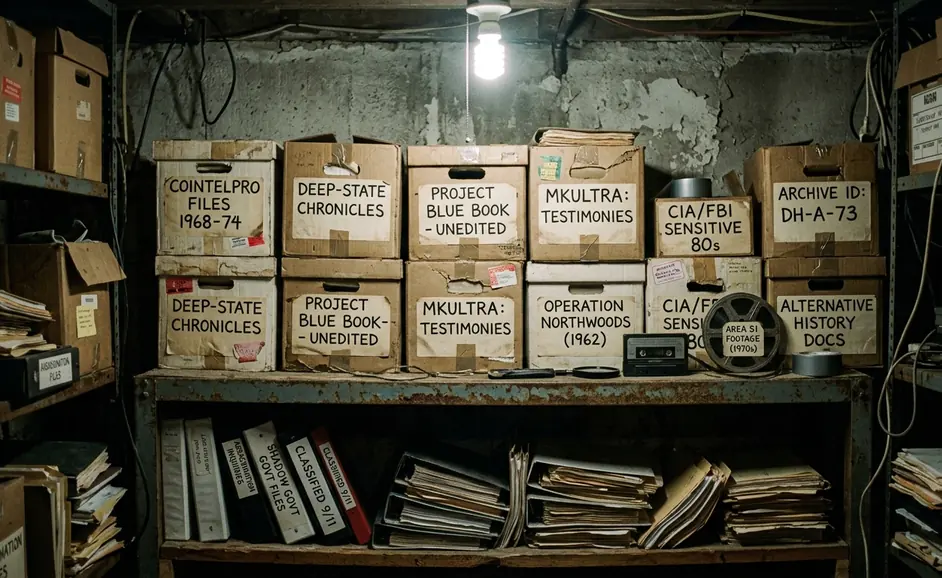
The Invention Secrecy Act of 1951 gives federal agencies a legal way to recommend secrecy orders on patent applications when disclosure may damage national security. Public patent-secrecy reporting showed more than 6,000 secrecy orders still in effect at the end of fiscal year 2023. That is not folklore. It is a working channel for technical suppression.
The leap comes afterward. Some researchers call the hidden network an ‘Alien Resource Cartel’: a coalition that allegedly suppresses alternative energy to preserve geopolitical control. The phrase captures a suspicion that has followed energy anomalies for decades. Yet the phrase itself does not supply custody records, independent replication, or recoverable devices.
Quick Tip: When reading a suppression claim, ask whether the cited mechanism is legal, technical, or testimonial. Those categories carry different weight.
Suppressed Physics and Skunk Works Confessions
A chain of custody problem
The recurring question is simple: who made the claim, when did it enter public circulation, what physical mechanism did it propose, and can anyone reproduce it?
Viktor Schauberger offers a useful test case. He lived from 1885 to 1958 and patented water-flow and turbine-related devices. His documented work concerns fluid dynamics, forestry, and implosion-themed engineering. Later writers linked Schauberger-style implosion devices to Third Reich disc aircraft during the 1940-1945 wartime period, but surviving public technical records do not establish a tested antigravity aircraft.
That distinction matters. Schauberger’s ideas deserve historical attention without turning every vortex patent into a spacecraft blueprint.
The Lockheed-adjacent story follows a different path. The statement that a major aerospace advanced-projects leader said the technology existed to ‘take ET home’ usually traces to recollections of a March 1993 university lecture and later secondhand accounts. The leader died in January 1995. His 1994 memoir documented stealth aircraft development, radar-cross-section engineering, and classified program culture, but it did not provide technical schematics for extraterrestrial propulsion.
Bob Lazar’s account adds more detail and more risk. He alleged in 1989 that a stable isotope of element 115 powered an antimatter reactor at S-4. Element 115 was first synthesized publicly in 2003 and named moscovium in 2016. Supporters see that later synthesis as suggestive. Skeptics answer that public synthesis of a superheavy element does not verify Lazar’s reactor, isotope stability, workplace history, or Papoose Lake facility claim.
Comparisons demonstrate the core problem: Schauberger gives historians patents and engineering themes; Lockheed lore gives researchers recollected speech; Lazar gives a detailed narrative with contested verification. Treating all three as one proof chain weakens the case rather than strengthens it.
Orbital Anomalies: The Black Knight and Phobos
How a legend accreted parts
The Black Knight story did not arrive as one clean file. It grew in layers.
First came long-delayed radio echoes discussed in the 1920s. In the early 1970s, those echoes were reinterpreted as a possible star-map message from Epsilon Boötis. The famous claim that the object has orbited Earth for 13,000 years comes from that decoding attempt, not from recovered hardware, an authenticated telemetry package, or a spacecraft inspection.
Then came the 1960 episode. In February and March of that year, U.S. space-surveillance tracking produced press reports about an unidentified object in polar orbit. Later explanations associated the object with human-made launch debris rather than a non-human satellite. The timing matters: the first successful U.S. polar-orbiting reconnaissance-related launches began in the 1959-1960 window, making debris in unusual inclinations more plausible after that point.
Finally came imagery. A frequently circulated Black Knight photograph comes from a December 1998 orbital mission image of a dark object outside a spacecraft. The documented explanation identifies it as lost thermal-blanket material.
Phobos and the temptation of shape
The Phobos monolith raises a quieter but similar issue. Mars Global Surveyor imagery captured a prominent object on Phobos, and the word ‘monolith’ naturally invites design language. The problem is not curiosity. Curiosity belongs here. The problem is using shape alone as a shortcut to agency.
Radar anomalies, radio-echo interpretations, space-mission photography, and Mars imagery require different evidentiary standards. A polar-orbit tracking report does not validate an Epsilon Boötis probe. A striking rock on Phobos does not authenticate a 13,000-year-old satellite in Earth orbit.
Alien Treaties and the Occult Connection
Provenance before interpretation
Alien treaty narratives usually begin with a familiar scene: a presidential meeting in February 1954 during a publicly reported California trip. Contemporary press accounts described the episode as involving a dental emergency. Later versions recast the gap as a meeting with non-human entities and the beginning of Technology Transfer Programs, or TTPs.
No authenticated treaty text, ratification record, diplomatic cable, or declassified presidential memorandum has been produced to verify a formal agreement with non-human entities. That absence does not settle every question about classified contact claims, but it does keep the treaty story in the testimonial and derivative-document category.
Alleged Majestic-style documents entered public circulation in the 1980s. An FBI file later marked one circulated set as bogus, making those papers weak documentary evidence for treaty claims. Reporting confirms that such documents have had cultural influence, but influence is not authentication.
Why the occult thread persists
The occult connection enters through Aleister Crowley’s Amalantrah Workings, conducted in New York from January to March 1918. The figure called Lam later became associated by occult writers with non-human or transdimensional contact themes. Crowley’s Lam image appeared in 1919 in an occult publication context.
The extraterrestrial interpretation came later. That sequence is important. Crowley did not leave a 1918 intelligence finding about aliens. Later writers connected occult contact imagery to UFO-era assumptions and then folded the result into treaty speculation.
The geopolitical version of the claim says these TTPs still shape tension between world leaders. It is a powerful story because it explains secrecy, energy dependence, and strategic distrust in one stroke. It is also too tidy. Without archival records, it remains a lens, not a demonstrated diplomatic history.
The Limits of Disclosure
Why secrecy can persist without proving the largest claim
The Breakaway Civilization thesis does not need aliens to explain persistence. Conventional national security can sustain secrecy. Institutional liability can sustain secrecy. So can extraordinary claims that lack releasable proof.
Executive Order 13526 allows classified information to remain restricted when disclosure is expected to damage national security, including intelligence sources, military plans, foreign relations, and advanced weapons systems. Recent UAP record-review mechanisms created in the 2022-2024 period emphasize collection, review, and declassification, while still preserving exemptions for sources, methods, and sensitive national-security material.
The Brookings report often appears in disclosure arguments as if it ordered silence. It did not. The report, formally titled 1959 Brookings Institution study in many popular references but delivered to NASA in December 1960, discussed how contact with a technologically superior civilization might affect human institutions. It drew on anthropological analogies. It did not conclude that society would inevitably collapse.
The March 2024 historical review by the federal UAP office reported no verifiable evidence of extraterrestrial craft possession or reverse-engineering programs after reviewing records, interviews, and historical allegations. That conclusion deserves attention. So does its limit: absence in reviewed material is not the same as omniscience.
Note: The most careful position is not blanket belief or blanket dismissal. It is category discipline: law with law, engineering with engineering, testimony with testimony.
True disclosure, if it ever arrives, may not come from governments. Governments classify, redact, and bargain. Independent technological breakthroughs would force a different kind of reckoning because working devices can be tested outside the mythology that surrounds them.
That is where the Breakaway Civilization claim remains most useful. It asks readers to inspect the seam between secrecy and science. The seam is real. The civilization behind it remains unverified.