In this Article
- Executive Summary: The Architecture of Modern Covert Warfare
- The Privatization of Shadow Warfare
- Biometric Surveillance and Cyber Frontlines
- Historical Precedents: Proxy Conflicts and Intelligence Networks
- Scope and Limitations of Intelligence Oversight
Executive Summary: The Architecture of Modern Covert Warfare
Delegated authority, not a single hidden hand
Modern black ops rarely resemble the clean mythology of one secret room issuing orders to masked operatives. The harder pattern is more bureaucratic and more durable: delegated authorities moving through presidential findings, defense tasking, intelligence liaison channels, embassy security requirements, contractor statements of work, and partner-service arrangements.
That architecture matters because it spreads responsibility across compartments. Public U.S. contracting and congressional oversight records from the 2001-2014 Afghanistan and Iraq campaign period show repeated outsourcing of intelligence support, armed convoy protection, site security, interrogation support, aviation logistics, and biometric enrollment alongside uniformed operations. The state did not leave the field. It kept targeting authority, legal designation power, and strategic direction while private personnel handled guard-force duties, logistics, data processing, aircraft maintenance, and technical collection support.
The shift after 2001 was layered rather than total. A drone strike, a detention screen, a base-access check, and a convoy movement could sit in the same operational ecosystem while passing through different chains of command. That makes accountability less visible, not absent.
The new front line is administrative
Cyber warfare and biometric tracking moved from specialist edges into routine security workflows during the approximate 2004-2016 counterinsurgency period. Handheld identity devices, watchlist databases, signals exploitation, and network-intrusion reporting became field tools. A patrol could collect fingerprints; a border program could compare identity records; a compromised website could yield credentials from a defense contractor or diplomatic office.
Historical proxy warfare supplies the continuity line. Cold War liaison funding and deniable militia support in the 1979-1989 Afghanistan conflict did not disappear. Those methods evolved into remote targeting arrangements, blended state-contractor channels, and cyber operations where the operator, infrastructure, victim, and authorizing agency may sit in different countries.
Summary: The defining feature of contemporary clandestine operations is not invisibility. It is distributed control: state authority retained at the top, operational labor delegated outward, and evidence scattered across contracts, devices, databases, and partner services.
The Privatization of Shadow Warfare
Camp Integrity as a procurement story
Start with one compound near Baghdad's airport zone. Camp Integrity, a fortified private security facility in the mid-2000s, operated with blast walls, controlled entry points, weapons storage, vehicle staging, and secure movement planning. It was not a battlefield headquarters in the cinematic sense. It was a logistics and personnel hub built for a war in which diplomatic protection, convoy movement, reconstruction security, and intelligence-adjacent support had to function under constant threat.
That is the point. The privatization of shadow warfare did not begin with ideology. It moved through procurement. From 2003-2011, armed security contractors guarded diplomatic compounds, escorted convoys, protected reconstruction teams, and secured airfields in Iraq under defense and diplomatic channels. Blackwater, later known as Academi, became the public symbol, but the mechanism was broader than one firm.
How contracts became dependencies
Urgent wartime needs were translated into contract vehicles. Those contract vehicles created daily dependencies. Once a private security company controlled movement planning, convoy protection, and site access, commanders and embassy security managers had to plan around its capacity, its reporting habits, and its subcontractor network.
No-bid or limited-competition awards appeared most often where officials cited urgency, continuity of service, security classification, or lack of available government personnel. The oversight problem was therefore not only secrecy. It was fragmented responsibility among contracting officers, field commanders, embassy security managers, and sometimes host-nation authorities.
- Use-of-force reports could sit in one administrative lane.
- Weapons accountability could sit in another.
- Subcontractor vetting could fall between prime contractors and government managers.
- Incident documentation could become contested when witnesses, classified instructions, and local police channels diverged.
Congressional and inspector-general reviews between 2005 and 2011 returned to these issues because the legal category of the armed contractor was unstable in practice. Was he attached to a military mission, a diplomatic security requirement, a reconstruction project, or an intelligence support task? The answer determined who could investigate, who could compel documents, and which forum could punish misconduct.
Note: Describing all private security personnel as covert operators collapses important distinctions. Guard-force work, logistics support, intelligence analysis, aviation maintenance, and unauthorized misconduct can share a battlespace without sharing the same mandate.
Biometric Surveillance and Cyber Frontlines
What happens when identity becomes the battlefield?
In counterinsurgency and border-security environments, officials often face people without reliable documentation: detainees, local hires, migrants, base workers, and border crossers. The operational answer became database-driven control. First capture the body. Then compare it to a list.
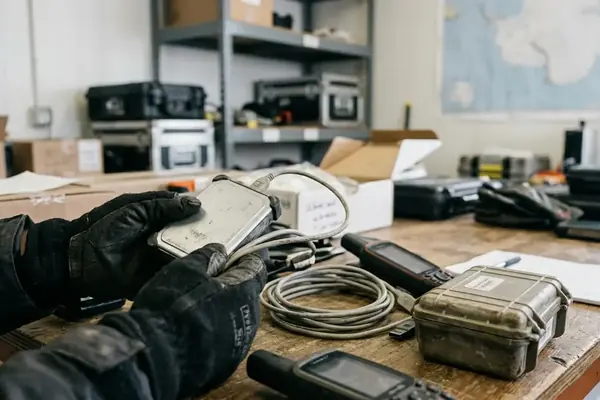
Portable multimodal devices such as SEEK II-class handhelds were designed for that setting. They captured fingerprints, iris images, and facial photographs in field conditions, then compared those records against locally stored watchlists or synchronized them with larger government biometric systems when connectivity allowed. The device made identity collection mobile. The database made it cumulative.
Available reporting indicates that, around the 2010-2019 period, U.S. military and homeland-security agencies expanded biometric collection across detention screening, base access control, local employee vetting, border interdiction, and migration-risk checks. Similar tools could appear in very different legal contexts. A combat detention screen, a foreign migration-screening program, and a domestic immigration arrest may all involve fingerprints or iris images, yet operate under different authorities, retention rules, and review mechanisms.
BITMAP and the export of the watchlist logic
The Biometric Identification Transnational Migration Alert Program, known as BITMAP, carried this logic outward. It was built around partner-country collection of fingerprints and identity records for comparison against U.S. security and immigration databases. Oversight reporting in the late 2010s described deployments across multiple foreign partner states, which matters because this was not merely a single-border tool.
The question is not whether identity checks have security value. They do. The sharper question is who controls the records, how long they remain useful, and what recourse exists when a person is misidentified or placed into a risk category through opaque matching. In field conditions, the answer is often partial.
Cyber operations follow the same logic of indirect access
State-sponsored cyber espionage, near the 2012-2021 period, commonly used spear-phishing, stolen credentials, compromised update channels, watering-hole sites, and zero-day exploitation against diplomatic, defense, energy, telecommunications, and research networks. The watering-hole method is especially revealing. Operators do not need to attack every target directly. They compromise a website already visited by the intended community, place exploit code or credential-harvesting infrastructure there, and wait for selected users to expose devices or logins.
The biometric device and the watering-hole site look unrelated. One sits in a dusty checkpoint; the other sits inside a browser session. Both reduce uncertainty by pulling a person, device, or credential into a comparison system controlled elsewhere.
Historical Precedents: Proxy Conflicts and Intelligence Networks
Tactical inheritance, not a master plan
The history of clandestine warfare is best read as inheritance rather than blueprint. Intelligence services adopted proxies when direct intervention carried diplomatic cost. They refined the practice when local partners offered terrain knowledge, political cover, and plausible distance from state sponsors.
South Asian intelligence competition from the 1970s through the late 1990s shows the pattern clearly. India's RAW and Pakistan's ISI operated in a regional contest shaped by propaganda, exile networks, covert training, militant patronage, and cross-border influence operations. The tools varied by theater: Punjab, Kashmir, Afghanistan, and border provinces each rewarded different combinations of psychological pressure, sanctuary, financing, and armed leverage.
Afghanistan and the logistics of deniability
During the 1979-1989 anti-Soviet war in Afghanistan, U.S. support to Afghan fighters moved through liaison channels involving Pakistan's intelligence service. Funding, weapons, training support, and distribution decisions were shaped by regional intermediaries rather than direct open U.S. command of every faction. That distinction is not a legal escape hatch; it is a description of how deniable support actually travels.

The Golden Crescent narcotics economy overlapped geographically with the Afghan conflict zone in the 1980s. A careful reading should describe this as intersection and tolerance within wartime logistics environments unless specific adjudicated findings establish direct official control. Open-source evidence can establish contracting structures, legal authorities, device capabilities, and documented oversight failures, but it cannot verify a specific classified operation without declassified records, court filings, inspector-general material, or corroborated official testimony.
That qualifier is not caution for its own sake. It protects the analysis from turning every shadow into a command chain.
From back rooms to remote air war
Cold War back-room bargains also shaped later drone-war arrangements. Reporting on the 2004-2018 period showed a recurring pattern: host-state officials could privately tolerate strikes while publicly objecting. The result was deniable consent, a policy form that allowed remote air operations to proceed while preserving political space for governments facing domestic opposition.
Comparisons demonstrate continuity in method, not sameness in technology. The militia camp, the liaison account, the covert air corridor, and the cyber intrusion campaign all solve the same political problem: how to act without owning the full public cost of action.
Scope and Limitations of Intelligence Oversight
Who has jurisdiction when authority is split?
Oversight begins with a practical question: which forum can reach the actor? Investigators first have to determine whether a contractor worked under a defense contract, diplomatic-security tasking, intelligence support arrangement, subcontract, or local partnership. Then they need evidence, witnesses, and unclassified facts that can survive in court or administrative review.
The Military Extraterritorial Jurisdiction Act of 2000, later amendments, the 2006 expansion of court-martial jurisdiction for some contractor activity, and federal criminal statutes created possible prosecution routes. In practice, overseas evidence collection, classified orders, witness access, and chain-of-command ambiguity often slowed or narrowed cases.
The Montreux Document and the limits of voluntary order
The Montreux Document, finalized in 2008, tried to clarify responsibilities around private military and security contractors. It describes existing legal obligations and good practices for states dealing with these firms. It does not create a standing international court or automatic licensing regime.
That limitation is central. Voluntary frameworks can shape expectations, procurement language, and diplomatic pressure. They cannot, by themselves, compel evidence from a classified operation or harmonize every legal system touched by a transnational security contract.
FISA was not built to govern the whole cyber battlespace
The Foreign Intelligence Surveillance Act was enacted in 1978 and substantially amended in 2008 for modern electronic surveillance issues. It remains primarily a U.S. legal framework for intelligence collection authorities, court approval, minimization, and targeting rules. It is not a comprehensive regulator of all transnational cyber operations.
Decentralized cyber activity exposes the gap. Infrastructure may sit in one jurisdiction, operators in another, victims in a third, contractors in a fourth, and command authority somewhere else during the same intrusion campaign. A legal regime designed around authorization and minimization can restrain parts of that activity, but it cannot automatically resolve attribution, contractor liability, partner-service conduct, or foreign evidence access.
Quick Tip: Follow the authority chain before judging the operation. In modern covert warfare, the decisive document may be a task order, a watchlist-sharing agreement, a diplomatic security contract, or a surveillance authorization rather than a dramatic secret memo.
The unseen global war is not unseen because it leaves no trace. It leaves too many traces in too many places. The work of analysis is to separate logistics from command, access from control, and deniability from ignorance.