In this Article
- How the evidence is graded before the chronology begins
- Why staged attacks differ from exploited crises
- The strongest documented cases: Tonkin, Gleiwitz, Mukden, Northwoods
- The mixed record around Maine, Ajax, Reichstag, and Nayirah
- How deception moves from incident to authorization
Executive Summary: The Architecture of Manufactured Conflict
A false flag operation is not just a lie. In intelligence history, it is an act planned or conducted by one party while being made to appear attributable to another. The essential parts are operational concealment, misattribution, and political exploitation.
That distinction matters here because the public phrase “false flag” often gets stretched until it covers every wartime rumor, every propaganda line, and every suspicious crisis. That is analytically lazy. The better method starts with evidence grading, then moves into chronology.
The strongest confirmed cases in this list include the Gleiwitz Incident on 31 August 1939, the Mukden Incident on 18 September 1931, Operation Northwoods as a drafted but unexecuted plan dated 13 March 1962, and the fabricated second Gulf of Tonkin attack reported on 4 August 1964. They do not all belong in the same evidentiary bucket.
Summary: Treat these cases in three tiers: executed deception, planned but unexecuted deception, and propaganda or atrocity claims later discredited. Tonkin, Gleiwitz, Mukden, and Mainila show how quickly official claims can become military authorization. Northwoods shows that senior officials can design false-flag-style proposals without carrying them out. Maine, Reichstag, and Nayirah require more careful wording because their historical importance lies in weaponized narrative, not settled operational authorship.
Criteria for Selection and Historical Scope
What qualifies an incident for a list like this?
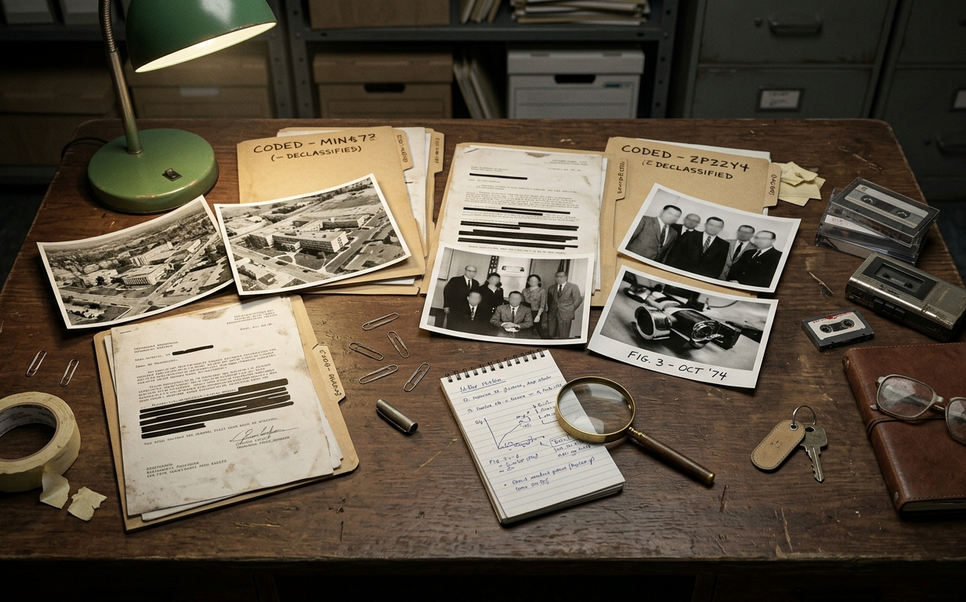
The filter used here is deliberately narrow: declassified documentation, official admissions, contemporaneous military orders, court or commission findings, postwar testimony, or later archival disclosures. The record shows a recurring problem in this field: the most dramatic claims often have the weakest paper trail, while the dullest memoranda sometimes carry the heaviest evidentiary weight.
Primary-source anchors include the 13 March 1962 Northwoods memorandum from the Joint Chiefs of Staff to the defense secretary, the 2005 historical study of the Gulf of Tonkin signals record, and the declassified 1953 coup history on Iran released in redacted form decades later. Readers who want to follow that documentary trail can begin with declassified signals intelligence reports and related archival collections.
For the 1930s cases, the record rests on different kinds of material: postwar testimony on Gleiwitz, the League of Nations Lytton Commission findings issued in 1932 on Manchuria, and the diplomatic record around the Soviet denunciation of the 1932 non-aggression pact with Finland on 28 November 1939.
The record is uneven by design: a memo can prove planning, while not proving execution; a technical review can weaken an official story, while not identifying a hidden perpetrator.
Note: Several entries below are historically important examples of deception or pretext-making, but not all are proven executed false flags or direct causes of global war. The USS Maine and the Nayirah testimony, for example, are better treated as weaponized narratives or manufactured atrocity propaganda unless the evidentiary distinction is stated plainly.
Declassified Deceptions: Incidents 1-5
1. The Gulf of Tonkin Incident (1964)
The cleanest lesson from Tonkin is not that nothing happened. On 2 August 1964, North Vietnamese patrol boats engaged the USS Maddox in the Gulf of Tonkin after U.S.-backed maritime raids under OPLAN 34A had targeted North Vietnamese coastal sites.
The decisive claim came two days later. On 4 August 1964, U.S. officials reported a second attack. Later signals analysis found that this second attack did not occur as claimed. President Lyndon Johnson addressed the public that same day, and Congress passed the Gulf of Tonkin Resolution on 7 August 1964, giving broad authorization for expanded U.S. military action in Vietnam.
The deception did not need to invent the entire theater. It needed to convert uncertainty at sea into legislative momentum.
2. Operation Himmler / The Gleiwitz Incident (1939)
Gleiwitz remains one of the starkest examples of a staged attack used to frame an enemy. On the evening of 31 August 1939, SS personnel staged an assault on the Gleiwitz radio station near the German-Polish border, broadcast a short anti-German message, and used murdered concentration-camp prisoners dressed as attackers as physical evidence.
Germany invaded Poland at dawn on 1 September 1939. Adolf Hitler referred to alleged Polish attacks in his Reichstag speech that same day.
Here the interval between theater and war was measured in hours, not weeks. The operation supplied a border script for an invasion that was already poised.
3. The Mukden Incident (1931)
On 18 September 1931, officers of Japan’s Kwantung Army detonated a small explosive near the South Manchurian Railway track outside Mukden. The damage was limited enough that rail traffic reportedly continued soon afterward.
The broader principle is familiar: a minor physical event, attributed to the target, can become a claim of defensive necessity. In Manchuria, that claim helped justify military expansion under the language of security and retaliation.
The League of Nations Lytton Commission findings issued in 1932 remain central to understanding how the incident looked once outside investigators reconstructed the political sequence.
4. Operation Northwoods (1962)
Northwoods occupies a different category. It was not an executed attack. It was a drafted plan.
Dated 13 March 1962, the Northwoods memorandum moved from the Joint Chiefs of Staff to the defense secretary and proposed false-flag-style scenarios that could create a pretext for military action. Its importance lies in the paper trail: senior officials approved concepts that would have used misattribution and civilian emotional targeting as instruments of policy.
That makes Northwoods powerful evidence of planning culture, not proof of an operation carried out. The distinction is not cosmetic. It is the line between documentary alarm and historical overclaim.
5. OPLAN 34A and the Concealed Tonkin Context (1964)
OPLAN 34A was not a false flag in the strict sense used here. It matters because it shaped the environment in which the Gulf of Tonkin claims landed.
U.S.-backed maritime raids had targeted North Vietnamese coastal sites before the Maddox incident. When officials framed the naval encounter for public consumption, that background was not foregrounded with the same urgency as the alleged attack. The result was not fabricated perpetrator identity; it was selective context in a fast-moving crisis.
That is why this entry belongs as a boundary case. It shows how covert pressure can set the stage for later misrepresentation without itself becoming a textbook false flag.
Manufactured Pretexts: Incidents 6-10
6. The Mainila Incident (1939)
Mainila shows how accusation can outrun inspection. On 26 November 1939, Soviet authorities accused Finnish artillery of shelling the village of Mainila near the Soviet-Finnish border and claimed Soviet casualties. Finland denied responsibility and proposed a mutual border withdrawal and investigation.
The diplomatic sequence then tightened. The Soviet Union renounced the 1932 non-aggression pact with Finland on 28 November, broke diplomatic relations on 29 November, and invaded Finland on 30 November, beginning the Winter War.
The pattern was compressed: claim, treaty rupture, diplomatic break, invasion.
7. The USS Maine Explosion (1898)
The USS Maine exploded in Havana Harbor on 15 February 1898, killing 266 U.S. sailors and Marines, as commonly cited. An 1898 naval inquiry blamed an external explosion. Later technical reviews have treated an internal coal-bunker or magazine-related explosion as more plausible.
This is not a proven Spanish false flag, nor a proven U.S. self-attack. It is a case of narrative weaponization. “Remember the Maine” became a mobilizing slogan in early 1898, and the United States declared war on Spain in April 1898 after weeks of press agitation, diplomatic breakdown, and congressional action.
The lesson is uncomfortable: a state does not need to stage an event if the political system can convert ambiguity into war fever.
8. Operation Ajax (1953)
Operation Ajax sits closer to covert destabilization than to a battlefield false flag. In August 1953, U.S. and British intelligence services supported a campaign against Iranian Prime Minister Mohammad Mosaddegh involving paid demonstrators, planted press stories, royalist coordination, and staged street disorder.
The target was not an invading army. It was political legitimacy inside Iran. Fake communist threats and manipulated unrest helped produce a climate in which Mosaddegh could be portrayed as a danger rather than as an elected leader under pressure.
Ajax belongs in the same family of state deception, but through a different mechanism: not a single staged attack, but a managed information and street-pressure campaign.
9. The Reichstag Fire as Disputed Pretext
The Reichstag Fire produced immediate authoritarian legislation, yet attribution remains contested. That is the central fact to hold in place.
As a historical mechanism, it matters because crisis claims moved rapidly into emergency power. As a false flag case, it remains weaker than Gleiwitz or Mukden because the operational authorship has not reached the same level of settled documentation.
So the cautious label is “disputed pretext use,” not confirmed staged attack.
10. The Nayirah Testimony as Atrocity Propaganda
The Nayirah testimony belongs in the propaganda fabrication tier. Its significance lies in how atrocity framing can shorten public tolerance for uncertainty.
It is not a classic false flag involving disguised attackers. It is a case where an emotionally potent civilian-victim narrative entered the political bloodstream and later faced serious discrediting. That distinction prevents the analysis from treating every deception technique as the same tool.
In narrative warfare, images of innocent victims often do what technical claims cannot: they push audiences away from verification and toward moral urgency.
Analyzing the Blueprint of State-Sponsored Deception
What repeats across these cases?
First, compressed decision windows. Tonkin moved from reported attack on 4 August 1964 to congressional authorization on 7 August 1964. Mainila moved from accusation on 26 November 1939 to invasion on 30 November 1939. When the clock is shortened, scrutiny becomes a procedural luxury.
Second, evidentiary asymmetry. Initial claims were public and urgent, while corrective records appeared years or decades later: postwar testimony on Gleiwitz, documents released after the Cold War, and signals-intelligence reviews published long after Vietnam escalation.
Third, civilian emotional targeting. The Maine, Nayirah testimony, and Northwoods proposals all involved narratives of innocent victims or attacks on civilian spaces. That framing carries political force because it makes hesitation look like indifference.

Quick Tip: In real time, track whether officials provide physical evidence, chain-of-custody details, independent inspection access, and raw intercepts before demanding retaliation. Absence of those items does not prove deception, but it should slow certainty.
A rigorous reading labels each case by mechanism: staged attack, fabricated attack report, proposed false flag, covert destabilization, disputed arson, or propaganda fabrication. That taxonomy is less dramatic than a single sweeping accusation. It is also harder to manipulate.
Skepticism is not cynicism. It is the minimum discipline required in an era when information moves faster than evidence, and when states understand that the first story often shapes the battlefield long before the archives open.