In this Article
- Executive Summary: The Pivot to the Pacific
- Criteria for Selection: Tracking the Invisible Hand
- 1. Synchronized Regional Trade Agreements
- 2. Elite Corporate-Government Revolving Doors
- 3. Standardization of Central Bank Digital Currencies
- 4. Trilateral Membership Among Key Asian Diplomats
- 5. Coordinated Responses to Energy Crises
- 6. Shifts in Supply Chain Hegemony
- 7. Media Consolidation and Narrative Alignment
- Scope and Limitations
- Conclusion: Influence Without a Single Lever
Executive Summary: The Pivot to the Pacific
The Trilateral Commission matters in modern Asian politics not because it legislates, commands, or openly governs. It matters because it sits in the narrow space where elite access, policy language, and institutional incentives meet.
Founded in 1973 as a private transnational policy forum linking North America, Western Europe, and Japan, the Commission later broadened its Asia-Pacific grouping as regional economic weight shifted toward East and Southeast Asia. That historical movement tracks a larger transfer of strategic attention: from Atlantic reconstruction and Cold War management toward Pacific production networks, digital payment systems, energy transition finance, and supply-chain security.
Summary: The clearest influence vectors from 2010-2024 are trade rules, technology standards, energy-transition language, and diplomatic networking. The Commission does not pass laws or issue binding central-bank rules. Its observable role is convening, agenda diffusion, and elite policy coordination.
I treat this inquiry as a claim audit, not a certainty claim. The relevant question is not whether a hidden committee secretly runs Asia. The better question is narrower: when Asian governments adopt similar treaty clauses, digital-finance vocabulary, governance codes, or strategic language, can we trace those choices through public rosters, meeting programs, advisory roles, draft papers, and appointment records?

Criteria for Selection: Tracking the Invisible Hand
What counts as evidence?
A policy resemblance is not enough. Governments copy language for many ordinary reasons: trade lawyers reuse treaty architecture, central banks share technical vocabulary, and ministries borrow from international templates when drafting under pressure.
The evidentiary chain needs steps. First, identify a public policy change. Second, compare timing and clause-level language against Commission-linked reports, meeting themes, or elite-policy discussions. Third, map the people: public membership rosters, archived programs, ministerial biographies, parliamentary records, treaty annexes, central-bank consultation papers, corporate-governance codes, procurement notices, and media-ownership disclosures.
A defensible timeframe for modern Asian influence tracing is 2008-2024. The global financial crisis, regional trade integration, digital-payment modernization, and supply-chain security planning all intensified during that period.
Note: Public records can show access, overlap, and policy similarity. They cannot, by themselves, prove clandestine command authority, coercive control, or a single coordinated master plan.
The strongest clues appear at clause level. Terms such as investor arbitration, data-flow commitments, interoperable payment rails, climate-transition finance, supply-chain resilience, and public-private partnership language carry more evidentiary weight than broad agreement with liberal internationalism.
1. Synchronized Regional Trade Agreements
The treaty clause is where influence becomes testable
Start with a concrete example: a regional trade pact enters force or moves through accession talks, and its text contains familiar language on customs facilitation, intellectual-property protection, services liberalization, and digital commerce. From 2018-2024, several major Asia-Pacific frameworks moved along this path.
The broader principle is simple. Elite-policy influence is easiest to test where words become enforceable. Treaty clauses either exist or they do not. Some agreements allow foreign investors to bring claims against host states through international arbitration rather than relying only on domestic courts. The trigger is usually an alleged breach of investment protections such as expropriation, discriminatory treatment, or denial of fair process.
That structure resembles themes long present in transnational economic planning, including historical Trilateral economic directives concerned with open markets, investment security, and institutionalized cooperation.
But this is the one place where the failure case matters. A treaty may share liberalization language with elite-policy reports while omitting investor-state arbitration or adding domestic carve-outs. That weakens claims of synchronized external control. Each treaty must be checked article by article.
2. Elite Corporate-Government Revolving Doors
The revolving door is not a metaphor. It is an appointment pattern.
For 2010-2024, public biographies in several Asian jurisdictions show senior officials moving between finance ministries, central-bank advisory roles, sovereign investment bodies, trade-negotiation teams, university policy centers, and multinational board positions. The concern is not that expertise crosses sectors. States need technical competence. The concern begins when the same policy assumptions travel with the personnel and settle inside regulators that are supposed to discipline private capital.
Operational indicators include shared service on advisory councils, repeated co-authorship of policy papers, participation in closed policy dialogues, and later appointments to posts overseeing financial regulation, industrial policy, trade, or competition rules.
Governance convergence
Corporate-governance reforms across Asia during 2015-2024 commonly involved stewardship codes, independent-director requirements, disclosure rules, and minority-shareholder protections. Comparisons demonstrate real convergence, but the conclusion needs care. These reforms also served domestic market-development goals and international listing requirements.
The influence question, then, is not whether every reform was imported. It is whether elite networks narrowed the menu of acceptable reform choices before national parliaments, regulators, and publics entered the room.
3. Standardization of Central Bank Digital Currencies
Is technical alignment political alignment?
Between 2016 and 2024, multiple Asian central banks published CBDC research, ran retail-wallet pilots, or tested wholesale settlement models for interbank and cross-border payments. Common design features included tiered wallets, transaction limits, QR-based merchant payments, offline-payment testing, programmable settlement conditions, and anti-money-laundering identity checks.
Those similarities deserve attention. They also demand restraint.
Context-dependent variation matters: CBDC standardization can reflect anti-money-laundering compliance, payment modernization, sanctions-risk planning, or cross-border settlement efficiency. The same technical feature is not evidence of the same political motive in every Asian jurisdiction.
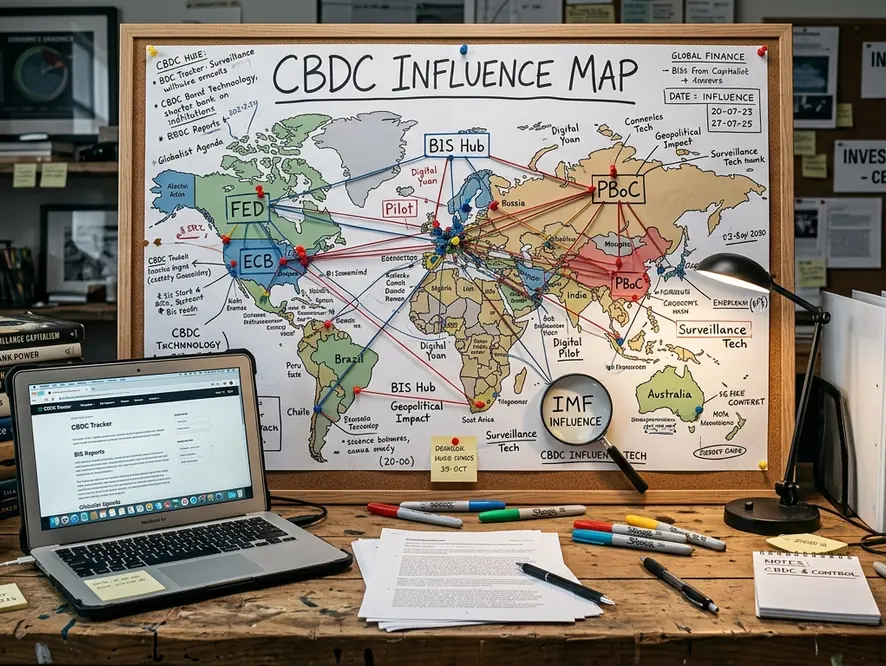
Cross-border prototypes in 2020-2024 focused on payment-versus-payment settlement, foreign-exchange liquidity management, and common messaging standards to reduce settlement time between participating central banks. The surveillance concern sits downstream from these design choices. A wallet system built around identity checks, transaction limits, and programmable conditions can support public oversight. It can also give states and partner institutions sharper instruments for financial monitoring.
Quick Tip: In CBDC research, read pilot documents before speeches. Wallet tiers, identity rules, settlement conditions, and interoperability tests reveal more than conference language.
4. Trilateral Membership Among Key Asian Diplomats
Picture the ordinary sequence. A former foreign minister appears on a public roster for a private policy forum. Months later, the same official uses familiar phrases in speeches: rules-based order, economic security, supply-chain resilience, digital governance, strategic autonomy.
That sequence is not proof of instruction. It is a lead.
The Trilateral Commission operates through regional groups and private plenary-style meetings. Public-facing materials typically list themes and participants but do not provide full transcripts of closed discussions. For 2000-2024, public rosters and biographies have included former heads of government, former foreign ministers, senior diplomats, central-bank figures, academics, and business leaders from Asia-Pacific jurisdictions.
The tracking method
A disciplined file compares a diplomat’s public statements around 6-18 months before and after forum participation. The analyst looks for repeated phrases, changed threat descriptions, new economic-security framing, or sudden emphasis on policy tools that later appear in ministry documents.
Informal networks can supersede official diplomatic channels without replacing them. The meeting does not need to issue an order. It only needs to align assumptions among people who already possess access to state machinery.
5. Coordinated Responses to Energy Crises
Energy policy shows how shared language can coexist with national stress. From 2020-2022, per documented metrics, major Asian economies announced or reaffirmed long-term carbon-neutrality targets with deadlines ranging from 2050 to 2070. They also increased support for renewables, grid upgrades, hydrogen, nuclear review, and energy-efficiency rules.
Then the 2021-2023 energy-price shock hit. Several governments combined fossil-fuel security measures with longer-term clean-energy plans. That pattern complicates the claim that a single ideological program simply displaced local energy independence.
Tracking data indicates that transition policy and energy-security policy often moved together. The sharper question concerns who financed and built the new infrastructure. Contract-consolidation claims require procurement evidence: repeated awards to the same consortium categories, shared advisers in feasibility studies, financing from the same development-lending channels, and procurement language favoring large integrated infrastructure providers.
Here the Commission’s likely influence is indirect. It helps normalize the grammar of climate-transition finance and public-private partnership. National ministries then translate that grammar into grid plans, hydrogen pilots, nuclear reviews, and efficiency mandates, each shaped by local constraints.
6. Shifts in Supply Chain Hegemony
Decoupling versus selective control
Two approaches now sit side by side in Asia. One approach keeps commercial exposure to rival blocs because factories, ports, and buyers remain entangled. The other tightens controls over chips, telecommunications equipment, strategic minerals, and defense-adjacent components.
From 2018-2024, technology supply chains were reshaped by export controls, pandemic-era logistics disruptions, semiconductor capacity incentives, rare-earth security planning, and efforts to place critical manufacturing in politically aligned jurisdictions. Concrete mechanisms included export-license screening, public subsidies for fabrication plants, tax incentives for advanced manufacturing, trusted-supplier requirements, local-content rules, and government-backed research partnerships.
Friend-shoring does not always mean full decoupling. In practice, it often means selective discipline: reward integrated economies, pressure non-compliant ones, and move the most sensitive nodes into jurisdictions trusted by security planners.
This is where non-state strategy becomes hard to separate from state doctrine. Policy forums may circulate the vocabulary of resilience. Governments supply the coercive tools.
7. Media Consolidation and Narrative Alignment
Who repeats the frame?
Media influence should be handled with particular caution. Public evidence can establish that some media board members also sit on policy, finance, academic, or philanthropic boards. It does not automatically establish editorial command over newsroom coverage.
For 2015-2024, media-concentration research in Asia commonly points to family-controlled conglomerates, state-linked broadcasters, cross-ownership by diversified business groups, and dependence on advertising or licensing relationships. These structures can narrow debate without anyone needing to send a memo.
Operational signs of narrative alignment include identical wire copy, synchronized headline framing, common expert sourcing, shared op-ed contributors, and repeated omission of dissenting parties across outlets during the same roughly 7-30 day news cycle.
Reporting confirms the basic ownership problem across many markets. The harder task is proving transmission from elite policy forums into newsroom decisions. That requires ownership filings, board biographies, editorial partnership disclosures, syndication arrangements, and close comparison of repeated narratives.
Scope and Limitations
Asia is not a passive surface for transnational design. Strong states, ruling parties, military establishments, bureaucratic traditions, family conglomerates, and nationalist movements all shape policy outcomes.
From 2010-2024, nationalist or state-capitalist governments repeatedly used capital controls, data-localization rules, domestic-content mandates, industrial subsidies, foreign-investment screening, and energy-price intervention even when those policies conflicted with liberalization preferences. Domestic pushback can derail externally favored policies through court challenges, parliamentary delay, provincial resistance, labor opposition, farmer protests, coalition politics, or bureaucratic non-implementation.
Note: Use this framework for mapping influence pathways, not for asserting direct control unless a document, payment trail, formal appointment, draft authorship record, or recorded instruction supports the claim.
The method has a blind spot specific to this topic: private meetings leave thin public records, while Asian bureaucracies often absorb outside vocabulary into domestic planning without preserving a visible drafting trail. That makes overclaiming easy and disciplined inference necessary.
Conclusion: Influence Without a Single Lever
The best-supported conclusion for 2008-2024 is measured but significant. Transnational policy forums helped normalize certain governance vocabularies in Asia: open trade, digital interoperability, climate finance, supply-chain resilience, public-private partnership, and rules-based diplomacy.
Documented forum access and elite overlap are strong evidence. Parallel policy language is moderate evidence. Claims of direct sovereignty capture are weak unless they show transmission through draft authorship, funding, advisory appointments, treaty text edits, procurement influence, or post-meeting policy reversals.
That does not make the inquiry harmless. Power often works through preparation rather than command. By the time a treaty clause, CBDC design feature, or supply-chain security rule reaches public debate, the acceptable options may already have been narrowed by people who met elsewhere first.