Seed monopolies do not announce themselves as monopolies. They arrive as drought relief, vitamin delivery, scientific modernization, crop insurance, and philanthropy. The public language is humanitarian. The operating structure is control.
The mechanisms are not mysterious: intellectual-property claims over traits and germplasm, licensing contracts that restrict saving or replanting, seasonal dependence on proprietary inputs, and public-private crop programs that reshape national seed systems from the inside. That is the architecture at issue here.
The evidence supports concentration, dependency, and policy leverage. It does not, by itself, prove that every seed vault, nutrition project, or GM crop trial answers to one centralized command. The deeper problem is less theatrical and more durable: institutions can converge without needing a single hidden switchboard.
In this Article
- The Illusion of Agricultural Philanthropy
- Doomsday Vaults and the Philanthropic Trojan Horse
- The Human Cost of Patented Life
- Blackwater, Agent Orange, and the Militarization of Food
- Reclaiming the Roots: Scope and Resistance
The Illusion of Agricultural Philanthropy
The modern food-control model works because it rarely looks coercive at first contact. A farmer sees a seed catalog, a credit offer, a pest-management promise, or a government-endorsed pilot program. A ministry sees a partnership. A foundation sees a nutrition intervention. A corporation sees future licensing revenue.
Those perspectives can coexist.
Commercial GM crop adoption accelerated after mid-1990s approvals, especially around herbicide-tolerant and insect-resistant traits in industrial commodity agriculture. The early sales pitch was direct: fewer pests, cleaner fields, higher yield potential. But once seed traits sit inside enforceable contracts, the seed ceases to be only a biological input. It becomes a legal instrument.
The three levers of control
- Genetic patenting and plant-variety rights: control over traits, germplasm, and breeding pathways.
- Input-credit dependency: seasonal purchases of hybrid seed, chemicals, and credit before harvest income arrives.
- Geopolitical food leverage: crop assistance, development policy, and resource allocation used as instruments of influence.
The Green Revolution language still matters because it supplies the moral frame. Who wants to argue against feeding the hungry? Yet the question is not whether hunger is real. It is whether hunger becomes the pretext for transferring seed sovereignty from farmers and public institutions to private rights-holders.
Summary: The central issue is not science versus superstition. It is whether biological inheritance becomes a licensed service controlled by firms, foundations, and strategic planners.
Doomsday Vaults and the Philanthropic Trojan Horse
What, exactly, is being protected when the world stores seeds in the Arctic?
The Svalbard Global Seed Vault opened in February 2008 as a fail-safe duplicate-storage repository for national and institutional seed collections. Seed boxes are deposited by approved institutions, sealed by those depositors, kept under cold conditions, and not handed out directly to farmers. Depositors retain ownership and withdrawal rights over their own material.
That detail matters. Treating the vault as literal private hoarding overstates the record.
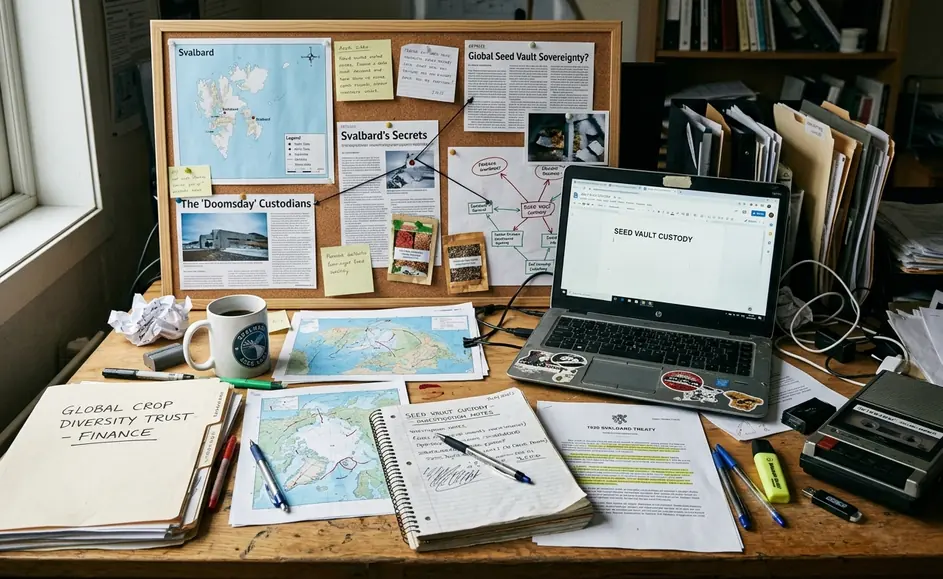
The sharper concern sits in the surrounding system. The facility is owned by a national government and administered with regional and international crop-trust partners. Large philanthropic donors, including the Bill & Melinda Gates Foundation and Rockefeller-linked agricultural programs over multi-year periods in the 2000s and 2010s, supported the wider crop-trust and biotechnology ecosystem. That creates an indirect funding relationship, not simple private ownership.
Still, indirect does not mean irrelevant.
Golden Rice and the nutrition corridor
Golden Rice was developed to express beta-carotene in rice endosperm and promoted as an intervention against vitamin-A deficiency. Regulatory approvals and court challenges in Southeast Asia unfolded from 2019 through 2024. The public argument focused on nutrition. The institutional effect was broader: biofortification opened a policy corridor for GM crop acceptance in countries where ordinary commercial arguments met resistance.
Early 20th-century philanthropic funding streams also deserve scrutiny. From roughly the 1910s through the 1930s, major foundation money moved through population science, heredity research, and eugenics-adjacent institutions. After the war, the emphasis shifted into molecular biology, agricultural modernization, and crop science from the 1940s through the 1960s.
The continuity is not a crude claim that every modern grant carries the same intent as an earlier eugenics program. The continuity is institutional: elites fund the science that defines which populations, crops, and reproductive systems become objects of management.
Note: The evidentiary hinge is convergence. Conservation infrastructure, biofortification programs, and intellectual-property regimes can align around control of germplasm access without proving a single master plan.
The Human Cost of Patented Life
Start in the cotton belt, not in a boardroom.
A farmer enters the season needing seed, credit, water, labor, and a price at harvest that can cover the first four. Bt cotton received official commercial approval in India in 2002. After that, seed pricing, technology fees, counterfeit seed, pest pressure, irrigation access, and informal credit became recurring flashpoints in cotton-growing regions.
Indian official crime-record data recorded more than 250,000 farmer suicides from 1995 through 2010. That figure covers all recorded farmer suicides, not only those tied to GM seed purchases. Collapsing every death into one cause would be analytically careless and morally cheap.
But debt pressure was real.
The dependency cycle
The mechanism usually worked like this: a farmer purchased hybrid seed and associated inputs before harvest, often through credit. If rainfall failed, pest pressure shifted, irrigation was unavailable, or crop prices fell, repayment arrived before recovery. In that setting, patented seed did not need to be the only cause of distress to become a powerful accelerant.
Mahyco Monsanto Biotech's Bt cotton became the emblem because it sat at the intersection of proprietary seed, technology fees, and state-level disputes over pricing and performance. Critics also pointed to so-called Terminator Seed technology, more formally known as genetic-use restriction systems designed to prevent viable second-generation seed. A major patent was granted in 1998, but public backlash led to non-commercialization pledges in 1999, and the technology did not become a standard commercial seed feature.
That distinction is important. The threat was not only what was deployed. It was what the patent system made thinkable.
What Sumant Kumar showed
Against this model stands the System of Rice Intensification, a set of field practices that emerged from Madagascar in the 1980s and spread through Asian farmer networks and development programs in the 1990s and 2000s. Its methods usually include younger seedlings, wider spacing, careful water management, and soil-aeration techniques.
Organic rice farmer Sumant Kumar became a reference point because his record-breaking yields challenged the assumption that productivity must flow from proprietary genetics and chemical packages. The broader principle is simple: agronomic knowledge can compound locally, while licensed genetics extract value externally.
That difference shapes sovereignty.
Blackwater, Agent Orange, and the Militarization of Food
The military history of agriculture is not metaphorical. It runs through chemical production, wartime contracting, herbicide commercialization, biotechnology acquisitions, and private-intelligence monitoring.
Agent Orange was supplied to the U.S. military during the Vietnam War era by multiple chemical manufacturers. Production and deployment concentrated in the 1960s and early 1970s, followed by long-running health and environmental litigation. Monsanto belonged to that industrial lineage, and the same sector later became central to agricultural herbicides and GM seed systems.
Glyphosate-based herbicide commercialization began in the 1970s. Herbicide-tolerant commodity crops entered large-scale commercial agriculture in the mid-1990s. The pipeline from chemical war to chemical farming was not direct, but it was institutionally legible: the same capabilities in synthesis, regulation, contracting, and liability management migrated into the food system.
When seed firms watch their critics
Reporting confirms that in 2008 and 2009, internal communications described a relationship between a major seed-and-chemical firm and Total Intelligence Solutions, a private intelligence company connected to Blackwater, later known as Xe Services. The services described included monitoring activists, critics, and public opposition networks.
That is the point where food politics leaves public debate and enters the security field. A corporation that treats dissent as an intelligence target has already reclassified agriculture as contested territory.
National Security Study Memorandum 200, completed in December 1974 and declassified in 1990, makes the state-level logic even clearer. It treated population growth in strategically important countries as a U.S. policy concern and discussed food assistance, development policy, and resource allocation as tools of influence.
I do not need to inflate that document into a cartoon. The documented claim is strong enough: food, population, and agricultural policy were explicitly treated as strategic matters by state planners. Anyone tracking food prices through the FAO food price index can see why. Food is not just nourishment. It is pressure, timing, compliance, and unrest.
Reclaiming the Roots: Scope and Resistance
The scope of corporate control is wide, but it is not unbreakable.
Consider legal immunity first. A short-lived U.S. appropriations rider signed on March 26, 2013 limited judicial disruption of already-approved biotech crop planting under certain conditions. Critics called it a shield for biotech agriculture. It expired on September 30, 2013. The dates matter because power often advances through temporary provisions that look procedural until they alter the balance between courts, regulators, and firms.
Patent fights show the same pattern. Civil-society groups challenged a claim involving medicinal or nutritional uses of fennel-flower extract during the 2010s, associated in public controversy with Nestlé. The useful distinction is narrow but important: such claims often target uses, extracts, or formulations, not ownership of an entire plant species. Even so, the direction of travel is unmistakable. Knowledge embedded in traditional plant use becomes a patentable commercial object.
Where resistance has already appeared
- Poland banned cultivation of the MON 810 maize line in 2013 while operating within a wider regional regulatory framework.
- India imposed a moratorium on commercial GM eggplant cultivation in February 2010 after public consultations, state objections, and biosafety controversy.
- Maharashtra moved against licenses or permissions connected to Bt cotton seed sales in 2012 amid disputes over pricing, performance, and regulatory compliance.
These reversals were not final victories. Administrative actions can be contested, modified, or absorbed into new regulatory settlements. But they prove that seed sovereignty is not merely sentimental language. It can take legal, agronomic, and institutional form.
Quick Tip: Follow the seed contract, not the press release. The contract reveals whether farmers can save seed, exchange seed, breed locally, and exit a failed input package without carrying debt into the next season.
The practical defense is agroecological farming, open-pollinated seed exchange, local breeding, and decentralized seed banks. Hybrid dependency is strongest where farmers must buy seasonal inputs through credit. It is weakest where communities retain seed memory, soil knowledge, and low-input systems.
That is why the seed question is ultimately a power question. Whoever controls reproduction controls the future harvest. Whoever controls the future harvest can bargain with hunger.
Reclaiming the roots is not nostalgia. It is the only viable defense against a food system that wants every seed to carry a license, every farmer to carry a debt, and every nation to negotiate its sovereignty at planting time.