Zero-point energy attracts two kinds of attention. Quantum physicists study measurable ground-state effects. Promoters attach the same language to machines that allegedly produce unlimited electricity. Any serious investigation has to separate those records before asking who might profit from the technology or suppress it.
The working verdict is clear: zero-point energy is a verified feature of quantum physics. Continuous commercial power extracted from an equilibrium vacuum remains unverified. That gap contains a legitimate engineering question, a crowded patent trail and a geopolitical argument that often runs far ahead of the documents.
In this Article
- What the vacuum ground state actually means
- How Casimir pressure becomes measurable
- Where proposed extraction systems get their energy
- What patent secrecy can and cannot establish
- How to investigate emerging vacuum devices
The Vacuum Begins at a Quantum Ground State
Start with the harmonic oscillator. Quantum mechanics assigns its lowest possible energy as E0 = ħω/2. The oscillator cannot settle at classical zero because its position and momentum cannot both become perfectly fixed. In quantum field theory, each field mode behaves mathematically like such an oscillator, carrying a ground-state contribution of ħω/2.
This is the disciplined definition of zero-point energy: the lowest energy a quantum mechanical system may possess. Empty space therefore retains quantum structure even after ordinary particles and thermal radiation have been removed from the description.
Why the Infinite Sum Is Not a Fuel Gauge
Summing the ground-state contributions of unrestricted field modes produces a divergent absolute value. Physicists ordinarily work with measurable differences between configurations or with renormalized quantities. Treating the formal sum as a conventional reserve of stored fuel skips the operation that would have to make some of that energy available while returning the apparatus to its starting state.
Since the Casimir prediction in 1948, experiments with atoms, superconducting circuits and nanomechanical structures have produced observable consequences from vacuum states. Across that same period, no independently replicated device supplied continuous net electrical output from an equilibrium vacuum.
The dual story begins here. Hard physics establishes fluctuations and ground-state effects. Geopolitics enters only when claims about practical devices, ownership and control acquire evidence of their own.
Two Metal Plates Put Vacuum Pressure on the Scale
Place two uncharged, parallel metallic plates extremely close together in a vacuum. The boundaries alter which electromagnetic modes can exist between the plates compared with the space outside them. The resulting difference produces an attractive force.
For ideal, perfectly conducting plates at zero temperature, the pressure is P = −π²ħc/(240a⁴), with a representing the separation. The negative sign denotes attraction. The inverse-fourth-power dependence explains why the effect rapidly fades as the gap widens: at 100 nanometres, the ideal pressure is about 13 pascals; at 1 micrometre, it is roughly 0.0013 pascal.
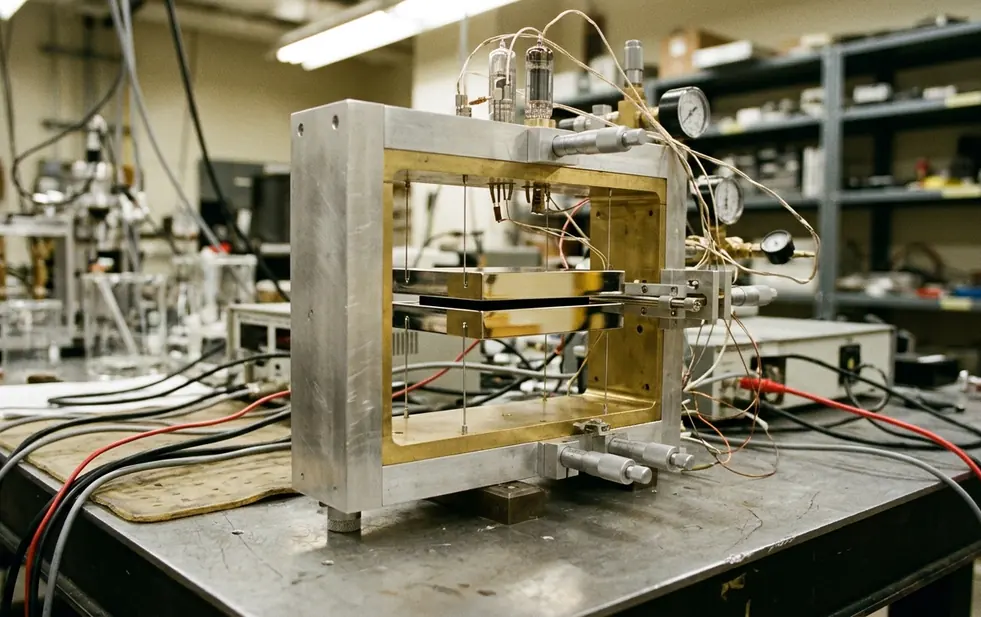
That steep distance dependence makes surface preparation part of the physics. Real measurements must account for finite conductivity, temperature, plate geometry, roughness and residual electrostatic patch potentials. Slight misalignment can overwhelm the signal being sought.
The interaction was predicted in 1948. Measurements since 1997 have tested it across separations ranging from tens of nanometres to several micrometres, including a published demonstration of the Casimir force.
Proof With Boundaries
The Casimir effect supplies physical evidence for a measurable, boundary-dependent vacuum interaction. It does not establish an accessible reservoir that can deliver unlimited work through a closed cycle.
Every Extraction Device Needs a Complete Energy Ledger
Can an engineer turn vacuum fluctuations into current? Proposed routes include nanomechanical oscillators, rapidly changing electromagnetic boundaries and asymmetric Casimir cavities. The useful answer begins by drawing a boundary around the entire apparatus.
A dynamical Casimir system changes a boundary quickly enough to generate real photons from vacuum fluctuations. Experimental demonstrations reported since around 2011 used driven superconducting circuits or related resonators. Those experiments represent genuine quantum engineering, yet the external drive supplies the usable energy. The observed photons do not constitute a free output.
The Start-Run-Reset Cycle
When I audit a vacuum-power claim, I divide it into four ledgers: the measured boundary force, external pump input, reset cost and independently measured electrical output. Cooling, modulation, switching and wear also belong inside the boundary. A transient pulse means little if restoring the oscillator or cavity consumes the apparent gain.
Asymmetric cavities pose a similar accounting problem. They can redistribute stress or create position-dependent forces. A closed-cycle calculation must include reaction forces on supports and cavity walls. No reproducible net-positive cycle has been established in peer-reviewed literature.
The materials challenge is severe. Casimir engineering commonly uses gaps of roughly 10 to 500 nanometres, with sub-nanometre roughness control in the most sensitive regimes. Candidate structures include multilayer conductors, graphene-like sheets, superconducting circuits and patterned metamaterials. Conductivity, temperature and residual electric potentials can change the result enough to mimic or bury the sought effect.
Overunity therefore remains the decisive test. A credible apparatus must produce more measured output than the complete start-run-reset cycle consumes without degrading the structure that creates the interaction.
Patent Secrecy Creates a Trail, Not a Working Generator
The legal machinery for withholding inventions exists. United States patent law has permitted secrecy orders since 1951 when officials judge publication detrimental to national security. An affected application may be withheld from publication and restricted from foreign filing.
Ordinary applications generally publish around 18 months after their earliest claimed filing date. A secrecy order interrupts that route and undergoes review on a recurring annual cycle. This demonstrated state capacity matters to investigations of intelligence and conflicts, alternative science and tech, and technologies with possible military use.
The harder claim concerns motive. A decentralized, high-yield energy source could threaten fossil-fuel revenue, centralized infrastructure and, in theory, the geopolitical arrangements associated with the petrodollar system. Those incentives offer a hypothesis about corporate agendas and state behavior. A hypothesis becomes a finding only when documents connect a particular decision to a particular technology.
The Missing Technical File
For the 2015–2025 period, investigators can examine annual secrecy-order totals, court dockets, declassified correspondence, patent-family histories and freedom-of-information releases. These sources can reveal timing, ownership, restrictions and legal disputes. Their limits are equally important: an order count discloses neither the technical contents nor the performance of the classified application.
The evidentiary boundary lies between an annual secrecy order and a released technical file demonstrating a closed-cycle Casimir or quantum-oscillator energy balance. Without that file or corroborating primary documentation, assigning a viable zero-point device to the classified inventory turns suspicion into assertion.
Trace Vacuum Technology From Claims to Priority Files
How can a reader distinguish serious quantum-device research from a repackaged “free energy” pitch? Search from the mechanism outward, then force every claim through the same documentary sequence.
- Run exact-phrase searches. Search patent abstracts, claims and descriptions for “stochastic electrodynamics,” “asymmetric Casimir force,” “dynamical Casimir effect,” “vacuum fluctuation” and “vacuum energy extraction.” Repeat the search with “ground-state energy,” “quantum vacuum” and “nanomechanical oscillator.”
- Locate the earliest priority document. Record its priority and publication dates, inventors, assignee category, legal status and related national filings. Consolidating those duplicates into one patent family prevents a single invention from appearing more widely replicated than it is.
- Read the independent claims first. Diagrams and promotional summaries can imply more than the legal claim covers. Check whether an examination report challenged utility or enablement, and inspect the cited non-patent literature.
- Match the mechanism to measurements. Review materials-science and quantum-device literature over a rolling 24–36-month window. Prioritize force-distance curves, device geometry, calibration methods, uncertainty budgets and disclosed pump power.
- Demand independent cycle accounting. Meaningful replication includes apparatus dimensions, controls, accessible measurement data and energy accounting across repeated start-run-reset cycles rather than one transient pulse.
A patent can establish that someone claimed an apparatus. A materials paper can establish that a nanoscale structure produced a measured response. Only independent, closed-cycle energy accounting can connect those records to power generation.
Open an international patent database now and run the exact phrase “asymmetric Casimir force”; record the earliest priority filing, its family members and every cited materials paper before reading the inventor’s promotional description.