In this Article
- The Crowded, Classified Sky
- Criteria for Selection: Defining an Orbital Anomaly
- 1. The 1960 ‘Dark Satellite’ Radar Mystery
- 2. Object 2014-28E: The Russian ‘Inspector’
- 3. The STS-88 ‘Thermal Blanket’ Discrepancy
- 4. The DSP-19 ‘Orphan’ Signal
- 5. The X-37B Classified Encounters
- The Future of Independent Orbital Tracking
The Crowded, Classified Sky
The Black Knight satellite survives because it bundles several attractive ideas into one story: a dark object, an ancient mystery, a NASA photograph, and the suspicion that official agencies know more than they say.
As a trackable spacecraft, though, it collapses quickly. The image set most often circulated under the Black Knight label comes from shuttle mission STS-88, flown from 1998-12-04 to 1998-12-15 during early assembly work on the International Space Station. The better editorial move is not to keep polishing that folklore. It is to ask a harder question: which orbital cases leave a real trace, yet still resist clean public explanation?
Summary: This article separates folklore objects with no stable orbital solution from real but disputed objects with public tracking signatures, launch context, photographs, radio claims, or withheld mission purposes.
- Earth orbit contains thousands of active and inactive objects, but it is not fully transparent.
- Some military payload identities, functions, and maneuver plans remain deliberately withheld or delayed.
- The strongest anomalies are not usually exotic. They are cases where records, behavior, and official explanations do not line up neatly.
That distinction matters. A legend can absorb any contradiction. A trackable object cannot. It has to pass through a sky, reflect sunlight, return radar, transmit radio energy, or appear in a mission record. Those traces are where the serious anomalies live.
Criteria for Selection: Defining an Orbital Anomaly
An orbital anomaly, for this list, must clear a narrow gate. It needs a documented orbit or attempted orbit, a stated detection method such as radar, optical tracking, or radio reception, and a bounded observation window. Open-ended legend is out.
What stays in
- Objects with anomalous radar returns tied to a known reporting window.
- Payloads or associated objects that maneuver after observers first classify them as debris.
- Public photograph sequences that intersect with a specific mission timeline.
- Radio or optical claims that can, at least in principle, be checked against timestamps, locations, and cataloged objects.
What stays out
- Ordinary spent upper stages.
- Insulation fragments with no later maneuver, signal, or identification dispute.
- Lens artifacts and single-frame curiosities.
- Already acknowledged military satellites, unless their behavior or misidentification creates a separate question.
Note: Absence from a public catalog does not prove extraterrestrial origin or exotic technology. Catalog suppression, classification, sensor geometry, and delayed publication can all produce temporary ambiguity.
This methodology is deliberately conservative. It favors cases that can be argued from records rather than mood. Civilian optical trackers are strongest with low Earth orbit objects crossing twilight sky; they are weaker with faint, high-altitude, low-reflectivity, or deliberately attitude-controlled spacecraft. That limitation shapes every case below.
1. The 1960 ‘Dark Satellite’ Radar Mystery
What did U.S. trackers see in early 1960?
Public reports of a mysterious dark satellite circulated in February and March of that year, just as the United States and the Soviet Union were building their first generation of orbital surveillance habits. The atmosphere around those reports was combustible. Military reconnaissance experiments were underway, launches were failing in public and succeeding in partial secrecy, and newspapers had more appetite than access.
The familiar retelling says neither superpower had polar-orbit capability at the time. That point does not hold up well. U.S. Discoverer-series launches from the West Coast had already attempted or achieved near-polar reconnaissance-test orbits in 1959. That does not erase the mystery, but it changes its shape.
The official explanation commonly cited for the object points to debris associated with Discoverer VIII, launched on 1959-11-20. In other words, not a self-powered unknown satellite, but a fragment from an existing military space effort.
Here is the rub: many later versions of the story lean on unsupported claims about mass, size, and trajectory. Without a primary radar-analysis document, those numbers are not stable enough to carry the case. Reporting confirms the more defensible anomaly is early-space-age uncertainty itself: fragment tracking, incomplete public disclosure, and rapid military experimentation created identification gaps in the 1960 reporting window.
2. Object 2014-28E: The Russian ‘Inspector’
Object 2014-028E is the strongest entry here because it moved from dull paperwork to operational significance in public view.
It was associated with a Russian military launch from Plesetsk on 2014-05-23. That launch placed several military communications satellites and additional associated objects into orbit. Western and independent observers initially treated 2014-028E as a possible leftover launch object, the kind of thing catalogs absorb and most readers never notice.
Then the object began to matter.
By late 2014, independent satellite observers reported deliberate orbital changes. The object maneuvered relative to the Briz-KM upper stage from the same launch, behavior inconsistent with inert debris. It became widely discussed under the Kosmos-2499 label, and the public debate shifted from ‘what fragment is this?’ to ‘what mission is it performing?’
The broader implication is uncomfortable but not speculative. Inspector-type satellites can approach, observe, and potentially characterize other orbital assets. They need not be weapons to change the strategic climate. A spacecraft designed to inspect can also map routines, test defenses, or signal capability.
Comparisons demonstrate why this case outranks the cleaner myths. It has a launch context, a catalog designation, an observation window from 2014-05-23 through late 2014, and behavior that forced observers to revise the initial debris assumption.
3. The STS-88 ‘Thermal Blanket’ Discrepancy
The STS-88 photographs are the trapdoor in the Black Knight story. They look strange enough to keep circulating, but their mission context is unusually strong.
STS-88 flew from 1998-12-04 to 1998-12-15 and supported early International Space Station assembly work involving the Unity node. The images most often reused in Black Knight claims show a dark, irregular object against Earth. Astronaut Jerry Ross later identified it as a thermal cover or blanket that came loose during the mission, not a separate spacecraft.
Skeptics point to the visual discomfort. In several frames the object appears dark, angular, and reflective along certain edges. It can look more rigid than casual viewers expect from a blanket.
That is a fair observation, but it is not enough. Crumpled multilayer insulation can rotate in sunlight and present hard-looking edges for a camera. Appearance alone is weak evidence without a matching orbital track, radio signal, or maneuver record.
Quick Tip: Treat a space photograph as the beginning of an inquiry, not the conclusion. Mission date, camera sequence, crew activity, and orbital behavior carry more weight than silhouette.
The failure case is clear: the STS-88 photographs cannot be treated as unexplained merely because the object looks rigid. The mission timeline and astronaut explanation give the thermal-cover interpretation a stronger evidentiary base than the Black Knight claim.
4. The DSP-19 ‘Orphan’ Signal
DSP-19 requires the most caution of any case in this list.
The spacecraft was a U.S. missile-warning satellite launched in 1999. It failed to reach its intended operational geosynchronous station after an upper-stage problem and did not serve as a normal Defense Support Program spacecraft. That alone makes it a legitimate object of interest: failed military spacecraft can sit in awkward orbital and documentary categories for years.
The orphan-signal claim is more fragile. Stories of unrecognized, encrypted telemetry bursts attributed to DSP-19 have circulated, but no widely available primary amateur-radio archive establishes a repeatable public record. A serious claim would need frequency, timestamp, modulation, observer location, recording metadata, and a reason the signal could not come from another satellite or ground source.
Zombie satellite behavior, as a category, is real. One experimental communications satellite launched in 1965 was heard transmitting again decades later. A scientific imaging satellite lost in 2005 was unexpectedly contacted again in 2018. Old machines can surprise their operators.
But category precedent does not authenticate a specific allegation. Plausible non-exotic explanations for unexpected signals from a failed military spacecraft include residual bus activity, transponder leakage, misattribution from a nearby object, classified secondary hardware, or ground-station test activity.
So DSP-19 sits here as a lead, not a verdict. The anomaly window begins with the 1999 launch failure and extends into later monitoring periods, but the encrypted-burst claim should not be described as confirmed without public logs.
5. The X-37B Classified Encounters
The X-37B shows how secrecy can create real observational ambiguity without requiring a single exotic claim.
It is an uncrewed U.S. military spaceplane operated for long-duration orbital missions. Public descriptions usually stay broad: technology testing, risk reduction, experiments. The mission durations, per documented metrics, show the trend. OTV-1 lasted from 2010-04-22 to 2010-12-03. OTV-5 ran from 2017-09-07 to 2019-10-27. OTV-6 lasted from 2020-05-17 to 2022-11-12.
Those long stays invite tracking. Independent optical networks have repeatedly recovered X-37B orbital paths after launch, especially when the craft was in low Earth orbit and sunlit against a dark ground sky. Tracking data indicates that large, reflective, repeat-pass objects are difficult to hide forever, even when their payloads remain opaque.
OTV-6 gives investigators a concrete reason to be careful. It included an acknowledged service module and an acknowledged small satellite deployment. That means companion objects may appear without proving a covert encounter, but it also means observers have reason to watch for uncatalogued or delayed-catalog bodies near the mission.
The strongest anomaly is not a single dramatic chase. It is the gap between observable facts and withheld purpose: orbit changes, long dwell times, payload secrecy, and delayed disclosure. In that gap, independent observers can document motion, but they cannot always name intent.
The Future of Independent Orbital Tracking
The next phase of orbital anomaly research will belong less to storytellers and more to careful observers.
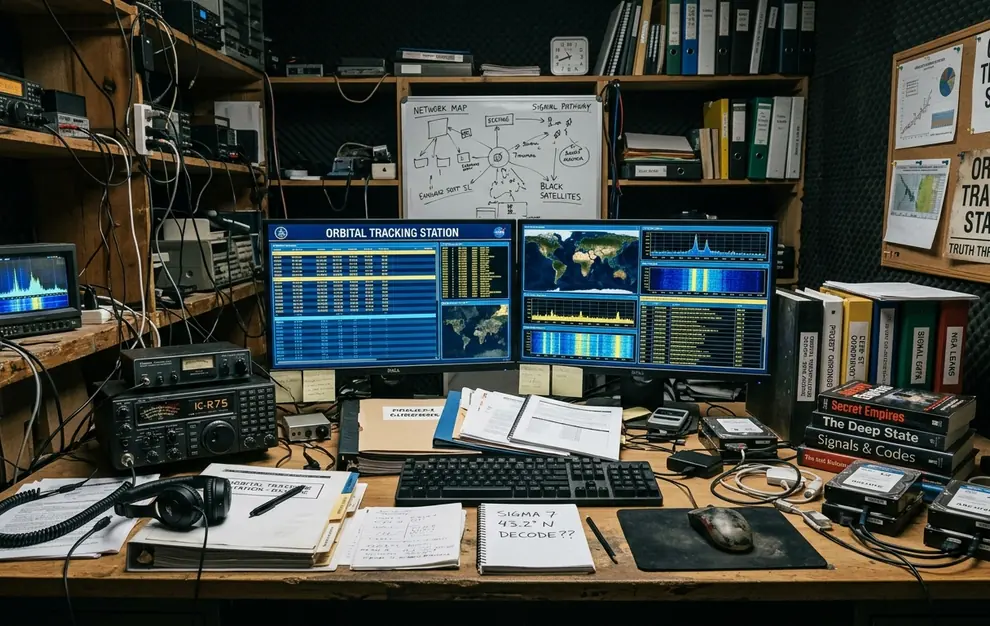
Modern independent tracking combines optical observations, public orbital elements, radio monitoring, image archives, and cross-checking by geographically separated observers. Low Earth orbit objects can be hard to hide for long when they are large, reflective, and repeatedly visible during dawn or dusk passes. Small, dark, high-altitude, or maneuvering objects remain much harder to characterize.
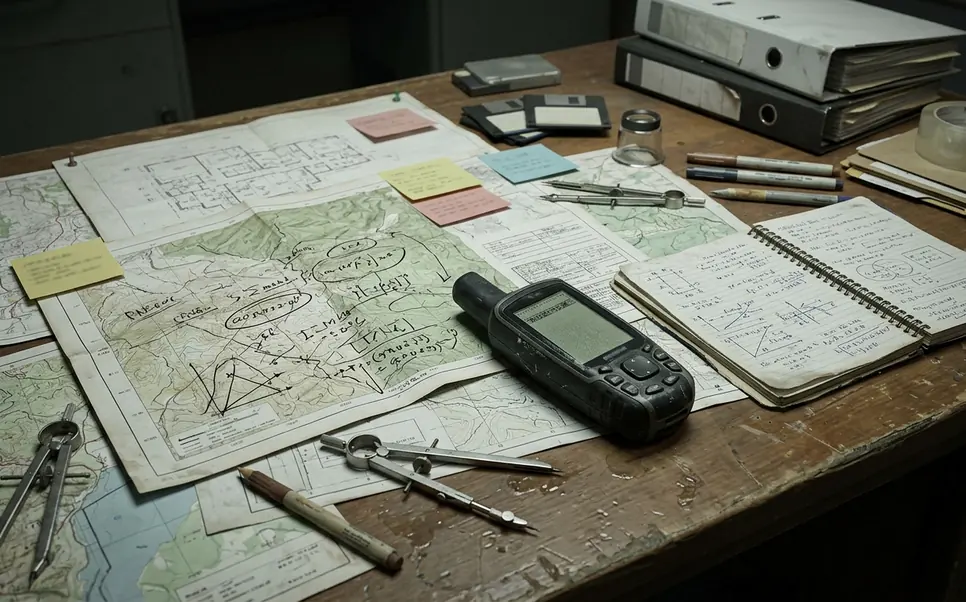
A field-ready verification loop
- Record the timestamp as precisely as possible.
- Log observer location, sky coordinates, estimated brightness, and angular rate.
- Capture radio frequency and modulation details if a signal is involved.
- Compare the sighting against the public catalog within the same 24-hour observation cycle.
- Ask geographically separated observers to attempt confirmation on the next pass.
Official disclosure still matters. Public official space object registries help create the baseline against which anomalies stand out. Yet national-security operators may have legitimate reasons to obscure payload functions, while civilian science and public accountability depend on enough disclosure to distinguish hazards, debris, experiments, and weapons-related systems.
The Black Knight myth endures because it offers certainty wrapped in mystery. The real sky is harder. It gives investigators partial tracks, delayed labels, cold spacecraft that wake up, and maneuvering objects that were not supposed to be interesting.
That is where the work belongs.